


The Pfynwald research platform 
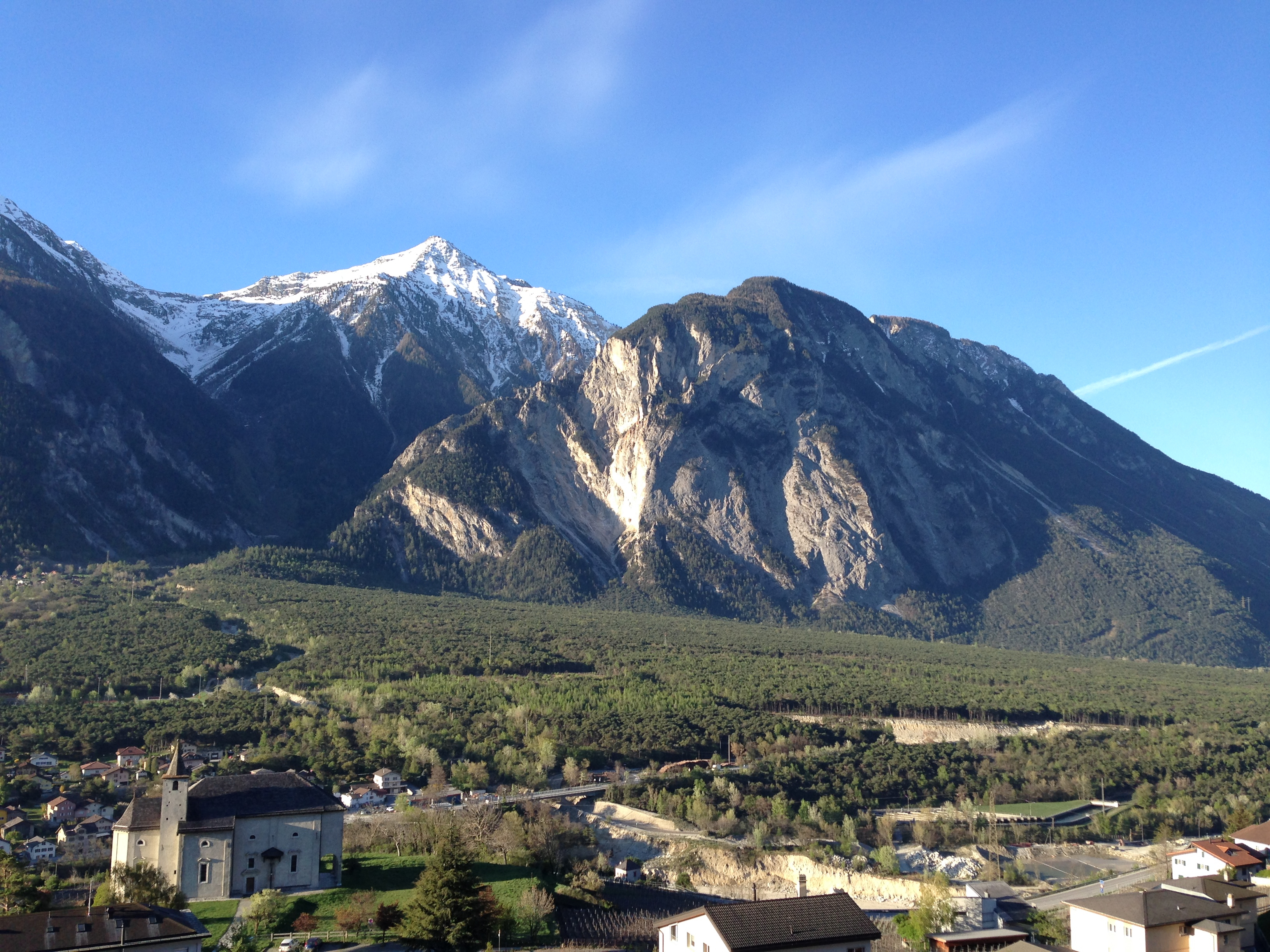
At the beginning of this century, numerous Scots pines in the Rhone Valley, one of the driest inner alpine valleys of the European Alps, situated between Brig and Sion (Canton Valais), started showing symptoms of drought. Many older trees had already died. To investigate the causes of the pine dieback, the WSL launched a long-term irrigation experiment in the Pfyn-Finges Nature Park in summer 2003. Since then, the WSL has been comparing the responses of several hundred Scots pines in irrigated forest plots with those of trees that continued to receive only the natural amount of precipitation.
Since 2024, we have implemented an additional, world-wide unique approach to disentangle the processes affected by atmospheric and soil droughts. For more details, see VPDrought-Experiment.
Contents 
Results from experiments in dry areas with a long series of in-situ measurements are necessary for a better understanding of the medium- to long-term effects of drought periods on forests.
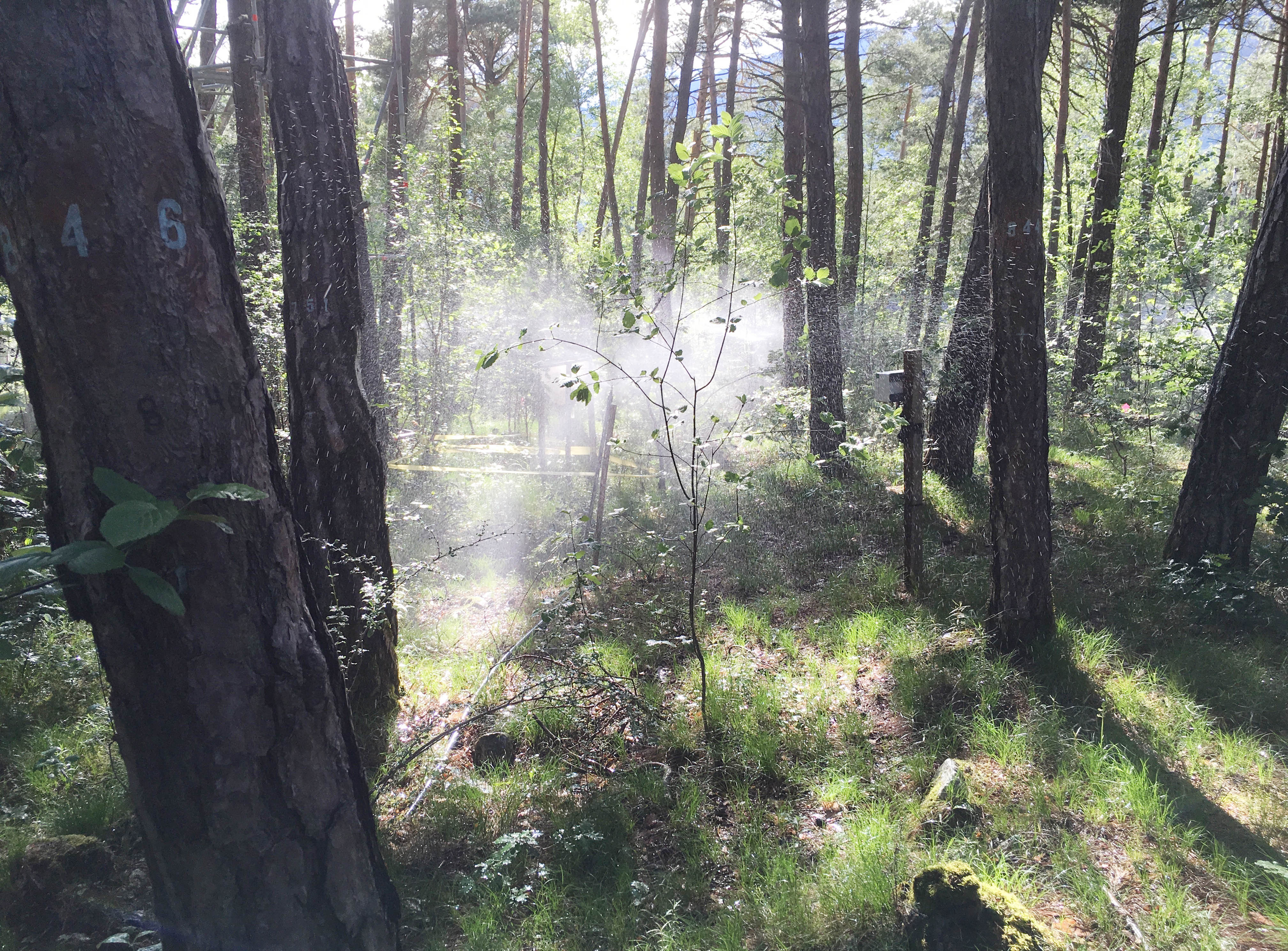
As the largest contiguous pine forest in Switzerland, the Pfyn forest in Canton Valais (46° 18' N, 7° 36' E, 615 m asl) offers the best conditions for such measurements. In light of this, a WSL research team set up a long-term experiment that is to last 30 years in this forest. The average temperature here is 10.6°C (average 1995-2014), the yearly accumulated precipitation is 575 mm (average 1995-2014). The pines are about 130 years old and 12 m high. The test area comprises approx. 800 trees over a surface of 1.2 ha divided into 8 plots of 1000 m2 each (Figure 4). Between April and October, four of these plots are irrigated by a sprinkler system which provides an additional 600 mm of water annually. In the other four plots, the trees grow under natural, hence relatively dry conditions.
Results to date 

Almost immediately after measurements began in 2003, a considerable increase in the production of mycorrhiza fruit bodies was noticeable in the irrigated subplots. After a one-year lag, the pines have been forming wider tree rings and longer needles than before since 2004. In the following years, the length of the height and branch shoots and the stand density increased as well. From the summer 2006, irrigation has also increased root growth and led to more biomass, especially in the fine roots (Brunner et al. 2009). The growth period of irrigated trees was extended by 2 to 5 weeks (Eilmann et al. 2010).
Over the entire experimental period from 2003 to 2019, the irrigation experiment allowed us to track the recovery trajectories in trees and in the whole ecosystem released from the natural dry conditions. The monitoring data over 16 years showed that irrigation improved the soil water availability, and 120-year-old Scots pine trees were able to regain vigor by increasing shoot length, needle length and leaf area, and by decreasing crown transparency.
We detected rapid and stronger responses from above-ground tree traits compared to below-ground tree traits. The altered above-ground traits during the initial years of irrigation increased the water demand. Trees adjusted by increasing root biomass during the later years of irrigation, resulting in an increased survival rate of Scots pine trees in irrigated plots. However, after reaching the peak in 2006, the magnitude of the impact of irrigation on a number of tree-related variables declined in the following years. This declining trend after reaching the peak may indicate that the water supply at a constant rate over the years did not meet the progressively increasing water demand from increasing vegetation activities.
The results indicate that increased water availability in the long term changed tree and ecosystem properties in a way that a new balance between soil water availability and water demand is reached, which changed the boundary conditions of the ecosystem. The irrigation also stimulated foliar decomposition rate at ecosystem level, biomass of fungal fruit body, and abundance of regeneration in broadleaved tree species. However, irrigation did not promote the regeneration of Scots pine trees, which are reported to be vulnerable to extreme droughts (Bose et al. 2022).
A novel approach to disentangle atmospheric and soil drought 
High evaporative demand (i.e., vapor pressure deficit or VPD) is an important factor influencing plant transpiration. VPD has increased in the context of global warming in recent decades, and can be referred to in highly simplified terms as "air dryness".
We aim to apply a scale-spanning approach to disentangle the processes affected by atmospheric (i.e., VPD) and soil droughts in mature Scots pine trees (Pinus sylvestris).
VPDrought is the first atmospheric humidity and soil moisture manipulative experiment worldwide in a mature natural forest. Under the tree canopy, we use rain shelters to divert 50% of the natural precipitation, thereby increasing soil dryness. In the canopy, a dry misting system increases air humidity, thereby reducing the VPD.
The system will be installed at the long-term Pfynwald irrigation experiment, a pivotal monitoring and experimental site in a pine forest in Valais, where the effects of soil drought have been studied since 2003 (see map). The site benefits from extensive data series, including more than 120 parameters collected at the tissue, tree, and ecosystem levels.
- Exhaustive information and access to data: vpdrought.wsl.ch

The map can be downloaded and printed in A3 or A0 format for field work.
In Switzerland, the temperature increase from the end of the 20th century to the beginning of the 21st was more than twice the global average. Climate models suggest that the 21st century will see a further rise in temperatures. In conjunction with the heat-related increase in evaporation and more frequent heat waves, it is safe to assume that the water supply available to trees is steadily deteriorating and that heavy rainfall is to be increasingly expected in the summer months. As this rainfall will increase surface water runoff and will not seep into the soil, plants will increasingly suffer from stress caused by drought. Consequently, the vitality and growth of the pines will drop. In the long term, drought may lead to an increasing number of tree deaths and cause vegetation areas to shift. This is particularly true for the forest ecosystem of inner-alpine dry valleys such as those in Valais (Rigling et al. 2013).
Links to the topic: Long-term Forest Ecosystem Research LWF, Sanasilva inventory