

19.01.2026 | Fabio Valsangiacomo | WSL News
Increasing heat and drought are putting our forests under stress. Researchers at the Swiss Federal Institute for Forest, Snow and Landscape Research (WSL) have used drone imagery to investigate how native tree species are responding to climate change. This measurement method opens up new possibilities for monitoring forests over large areas and documenting species-specific strategies for coping with drought.
- During the hot summer of 2023, researchers at WSL used drone footage to investigate how seven native tree species react to drought.
- Using special cameras, they identified species-specific differences in how trees cope with excessive sunlight and in the discolouration and defoliation of tree crowns.
- The measurements enable D'Odorico and her team to detect acute and persistent water shortages from the air. In future, this could help to monitor large areas of forest and identify which tree species are best able to cope with climate change.
Climate scenarios predict that the summer months will become hotter and drier. In order to increase the resilience of forests to climate change, forestry experts need to know how different tree species cope with higher temperatures and water shortages. The challenge is that these processes are highly complex. In addition, each tree species reacts differently to heat and drought, depending on its location. Until now, such studies have been costly and usually only possible for individual trees. Remote sensing using drones, aeroplanes or satellites is changing this.
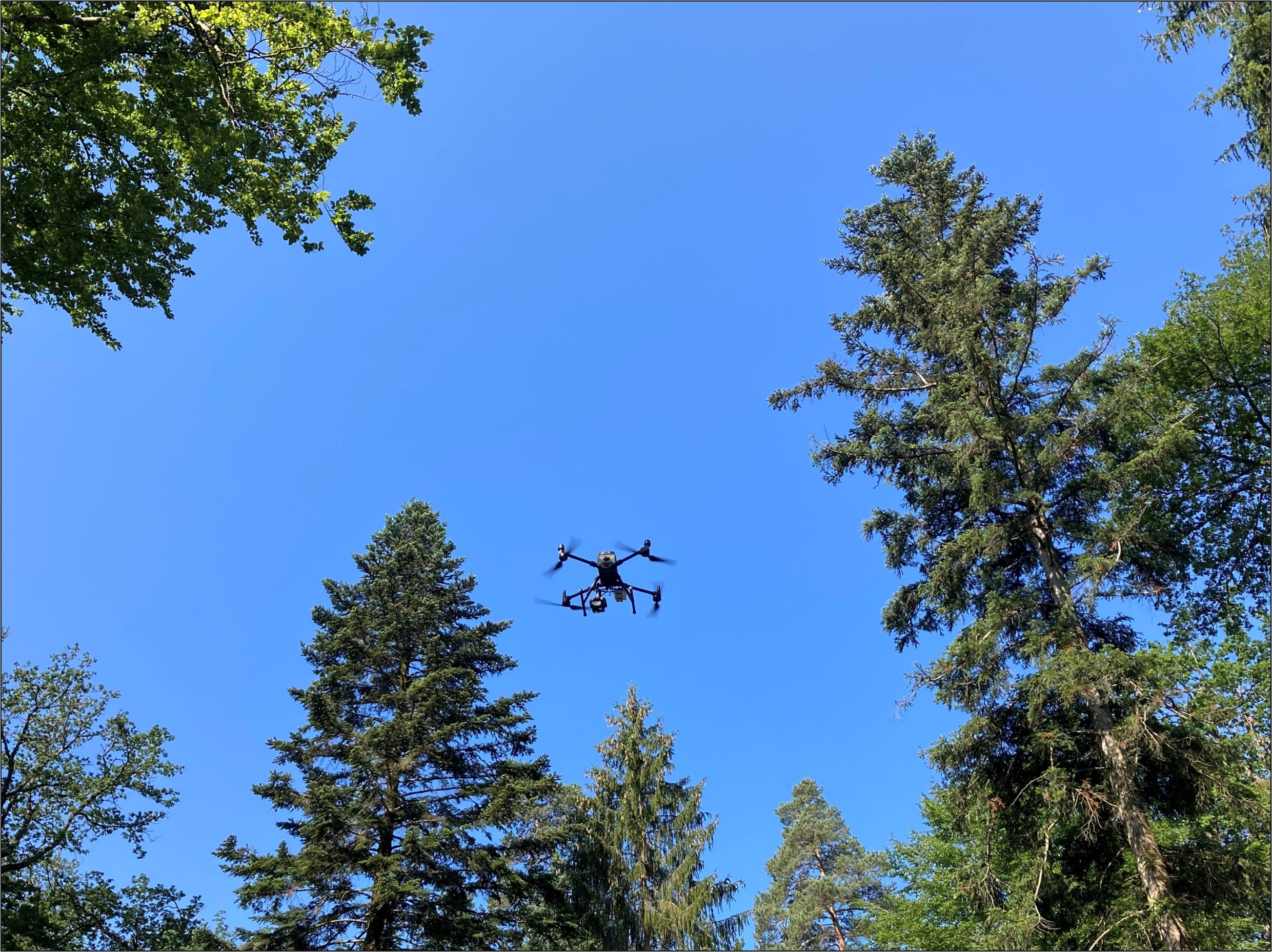
"We wanted to use drone imagery to find out how native tree species respond to drought and what strategies they employ. We did this both over the entire growing season and over the course of a single day," explains Petra D'Odorico, a geographer at WSL. She used special cameras to analyse changes in the crowns of seven native tree species (sycamore maple, oak, Norway spruce, hornbeam, European beech, Scots pine and silver fir). To do this, she repeatedly flew over the mixed forest of the Swiss Canopy Crane II (SCCII) research area of the University of Basel in Hölstein (BL) during the hot summer of 2023, where the data from the air could be compared with measurements taken on the trees.
Using drone imagery, D’Odorico was able to identify species-specific responses to drought. “For example, we observed that oak trees recover more quickly from a hot previous day than other tree species,” she explains, “or that conifers show delayed signs of drought stress and then suddenly die.” This measurement method could help to monitor large areas of forest in the future. D'Odorico is now also studying non-native trees, such as the Lebanon Cedar and the Oriental beech. Her aim is to identify species that could replace native trees in regions that are particularly affected by climate change.
Making drought stress visible 
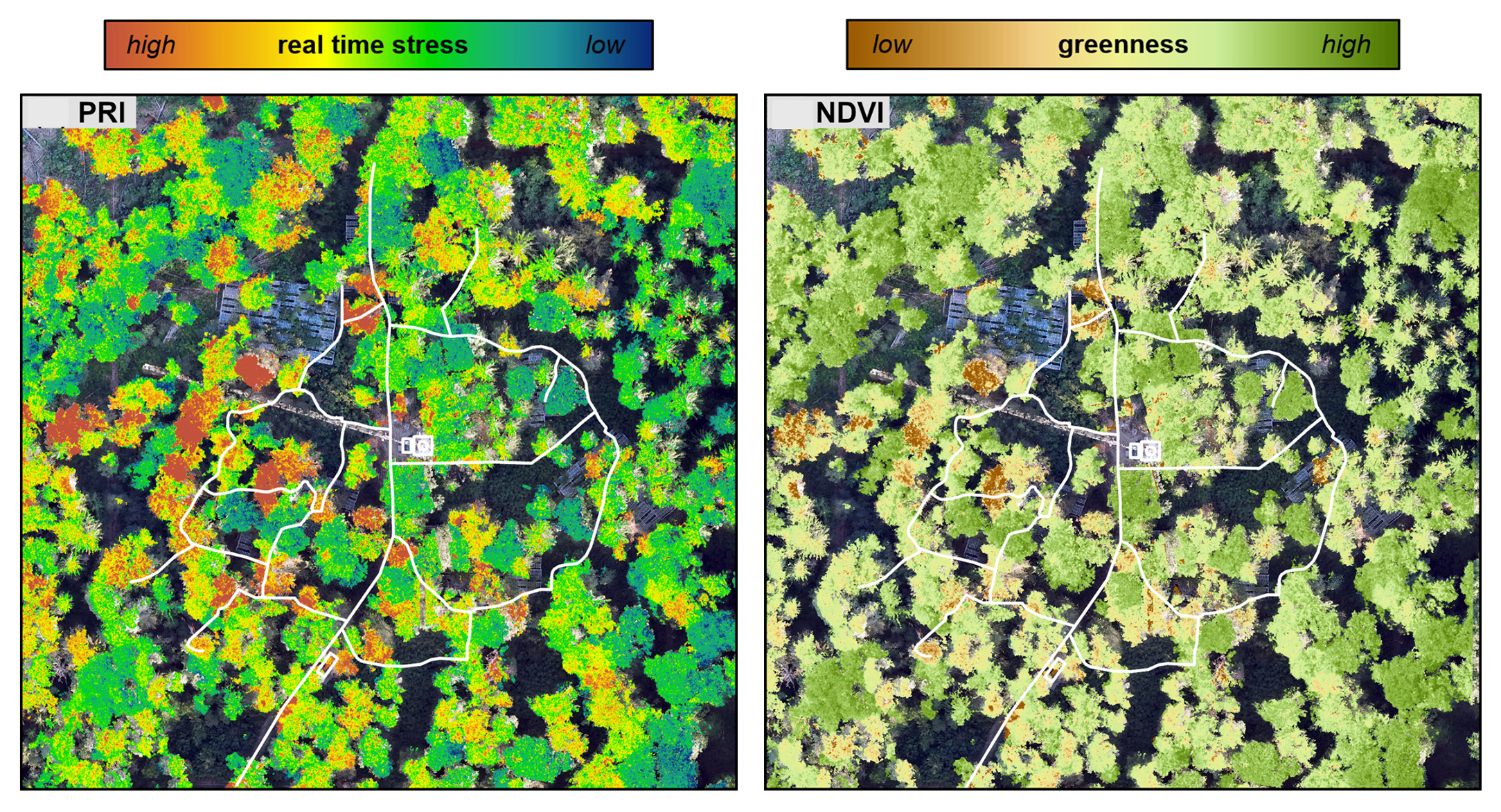
How can drought stress be detected from a bird's eye view? To find out, D'Odorico and her team used multispectral cameras that can also capture invisible areas of the light spectrum. The cameras detect a special pigment that trees produce to protect their leaves from excessive sunlight during drought conditions. ‘This allows us to identify whether a tree is under acute stress even before damage is visible to the naked eye,’ says D'Odorico. However, this short-term reaction does not tell the whole story. If the drought persists, the leaves change colour or fall off. In addition to light protection, the researchers therefore measure how green and how densely leafed the tree crown is. ‘The combination of both measurements gives us a better overview of exactly what is happening,’ summarises D'Odorico.
Contact 
Publications 
Projects 
Copyright 
WSL and SLF provide image and sound material free of charge for use in the context of press contributions in connection with this media release. The transfer of this material to image, sound and/or video databases and the sale of the material by third parties are not permitted.