

BioDetect - Deep Learning for Biodiversity Detection and Classification
2020 - 2022
Cooperation FinancingMonitoring biodiversity is essential for understanding and protecting ecosystems, but traditional field surveys are time-consuming and resource-intensive. With advances in remote imaging and machine learning, ecology is entering a new era of automated monitoring. However, the major bottleneck remains: how do we convert vast volumes of image data into meaningful ecological information?
In this collaborative project with the Swiss Data Science Center (SDSC) and EAWAG, we are developing open-source computer vision and deep learning tools to help automate biodiversity monitoring. By working with datasets from tropical ecosystems and Swiss freshwater habitats, our goal is to accelerate ecological research and provide tools that are accessible to researchers, conservationists, and citizen scientists alike.
Pollinators and Hummingbird Detection 

Pollinators play a critical role in ecosystem functioning and global food security. Among them, hummingbirds are key pollinators in the Neotropics, mediating complex interaction networks between plants and animals. Yet, detecting and studying their behavior at scale is a major challenge.
To address this, we developed a deep learning pipeline that automatically detects hummingbirds in camera trap footage. Working with data from Ecuador, Costa Rica, and Brazil, we trained a model capable of finding the few relevant frames (often <0.01%) among millions of images. This tool enables researchers to explore pollination interactions and network dynamics with unprecedented efficiency.
You can find and download our software hummingbird-classifier here: https://gitlab.renkulab.io/biodetect/hummingbird-classifier

Macrozoobenthos and Morphometrics for Freshwater Monitoring 

Macrozoobenthos are bottom-dwelling invertebrates such as insect larvae, worms, and mollusks, and are widely used as bioindicators of freshwater ecosystem health. Yet analyzing them requires labor-intensive manual processing of images under the microscope.
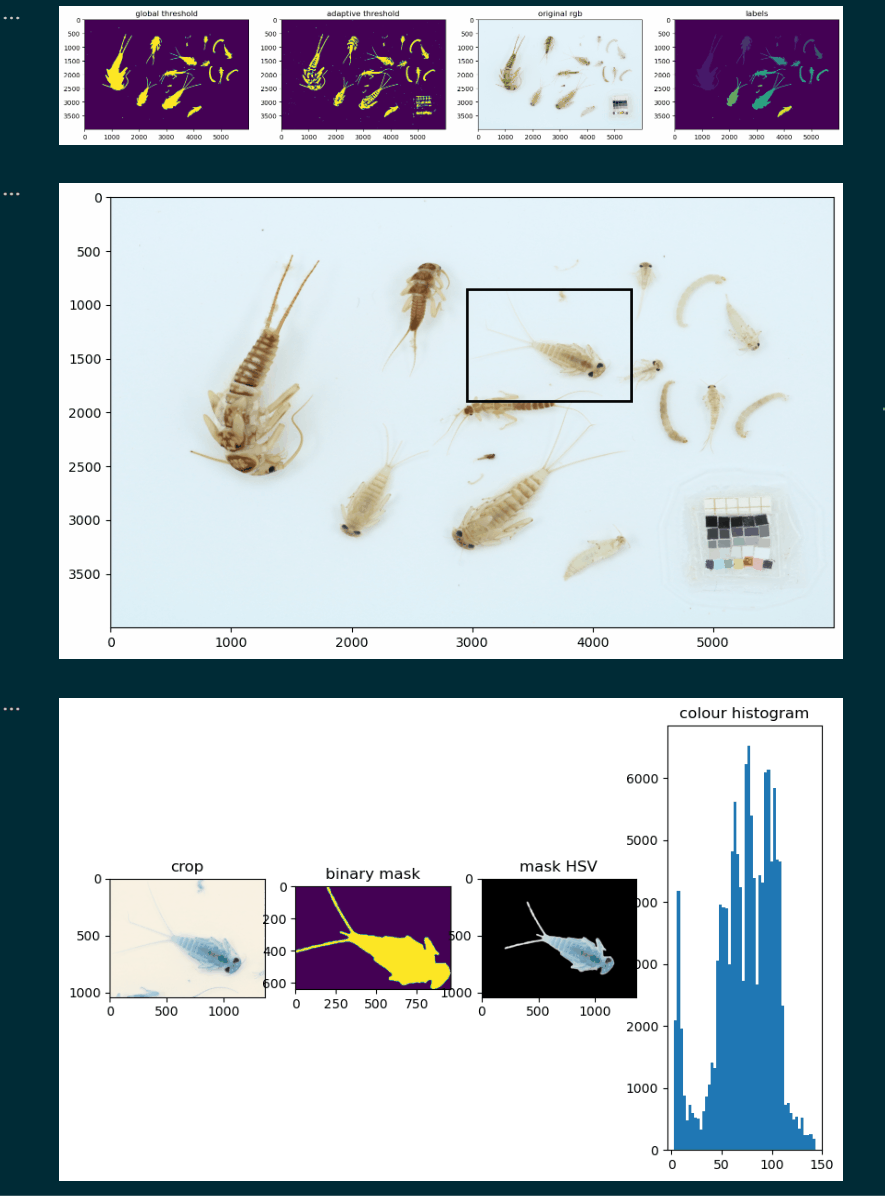
To streamline this workflow, we developed a set of tools for automatic segmentation (i.e. clipping), measurement (morphometrics), and classification of macrozoobenthos from image data. These tools support rapid, standardized assessments of freshwater quality and facilitate ecological research on trait-based responses to environmental change.
You can find and download our software mzb-suite here: https://gitlab.renkulab.io/biodetect/mzb-workflow
You can also find more information on the SDSC project page: https://www.datascience.ch/projects/biodetect