

Diversity under our feet - new ways to record soil organisms
Jessica Cuartero
Ivano Brunner
Benedikt Gruntz
Beat Stierli
Valerie Oriet
2025 - 2028
Cooperation FinancingSoils are among the most species-rich habitats on earth - more than half of the world's biodiversity is hidden beneath our feet. In addition to microorganisms, soil fauna fulfils key ecological functions. This ‘invisible’ living world, the so-called edaphon, is crucial for the functionality of our soils: it decomposes organic material, regulates the nutrient cycle, stores carbon, breaks down pollutants, controls pest populations, supports plant growth and contributes to soil structure. Unfortunately, we still know very little about biodiversity in soils and how it changes as a result of pollutant inputs, soil cultivation and climate change - not least because recording these organisms is methodologically complex and taxonomically challenging.
As part of our research, we investigate the diversity and composition of different groups of soil fauna - from tiny nematodes and microarthropods such as springtails and mites to enchytraeids and earthworms. We compare three methodological approaches:
-
Classical morphological determination
This proven method is based on the direct detection of organisms: earthworms are picked by hand from the soil and identified, nematodes and microarthropods are first isolated from the soil using the Oostenbrink or Macfadyen method and identified microscopically. -
DNA metabarcoding directly from soil samples (soil DNA)
Here, the DNA contained in the soil is extracted and analysed. This method is fast, efficient and allows many species to be identified simultaneously - even those that are dead or only present as fragments. -
DNA metabarcoding of the isolated soil fauna (e.g. nematode DNA)In this approach, the animals are first isolated from the soil and then identified by molecular genetics. This combination of classical extraction with molecular genetics offers high specificity and sensitivity and allows the genetic data to be directly assigned to specific animal groups.
Why a comparison of methods? 
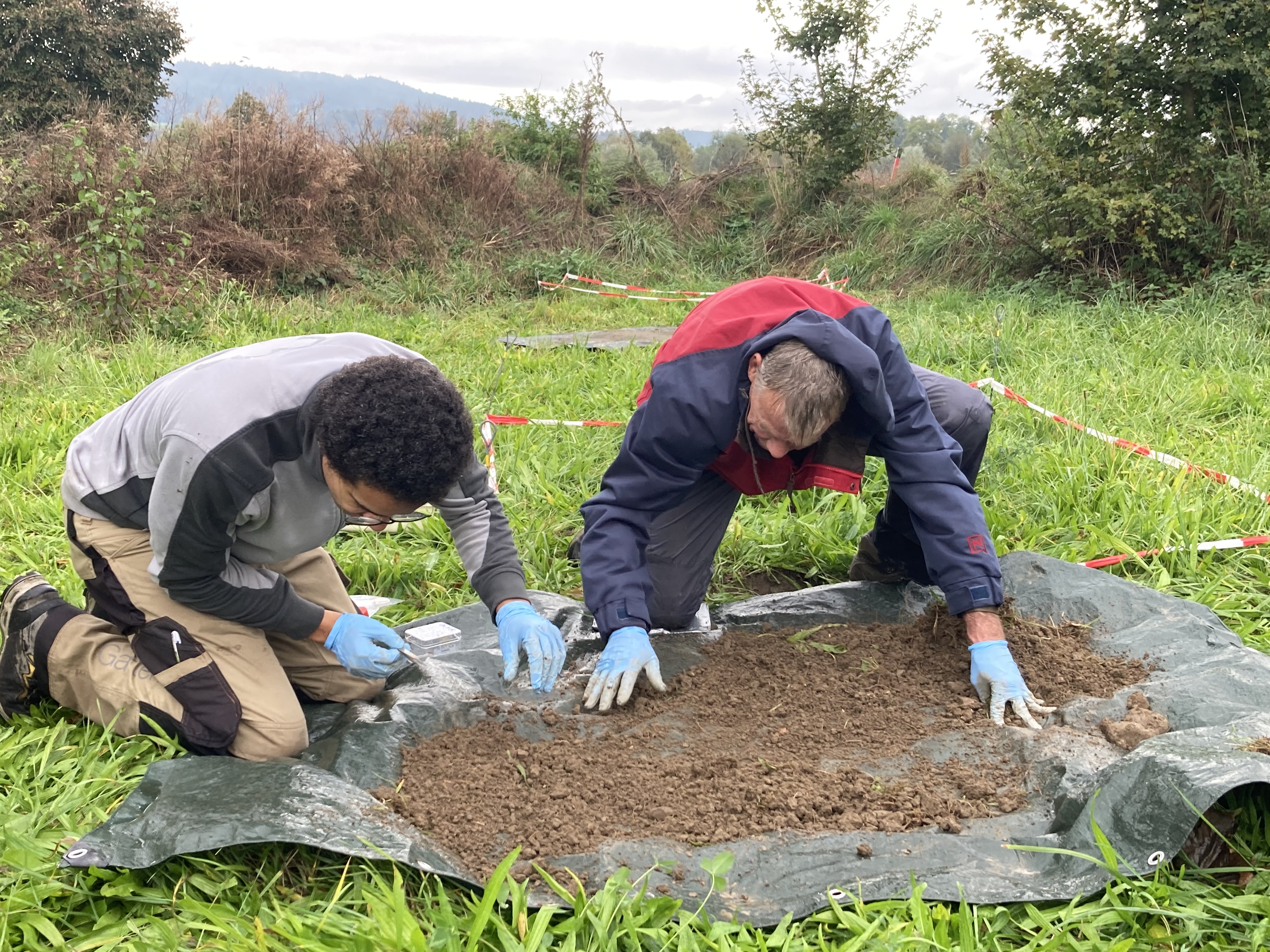
Traditional morphological identification has the advantage that it takes directly observable characteristics into account and often enables the precise classification of living animals - especially in the case of known species with well-documented characteristics. However, it is time-consuming, requires a great deal of taxonomic expertise and is only possible to a limited extent, especially in the case of small, cryptic or juvenile forms (e.g. larval stages). In addition, many groups - especially microarthropods - have such a large number of species that it is practically impossible to record them completely.
DNA metabarcoding, on the other hand, enables the rapid and standardisable recording of soil biodiversity via a genetic fingerprint. Specific marker genes are extracted from a soil sample and analysed using high-throughput sequencing. In this way, numerous species - including those that cannot be identified with a microscope - can be recognised simultaneously. A major advantage is that fragments, eggs or dead organisms are also recognised. However, the method is heavily dependent on the quality and completeness of the reference databases, which is currently still a challenge, particularly for animal groups that have not been studied much, such as certain mites or enchytraeids. In addition, DNA metabarcoding does not yet allow any statements to be made about the number of individuals or the life stages of the organisms.
What have we investigated so far? 
As part of several studies, we have analysed soil biotic communities in different habitats and under different environmental conditions - e.g. in a long-term irrigated dry forest in Switzerland and at 29 sites of the Swiss Soil Monitoring Network (NABO) with different land uses (forest, arable land, grassland). We specifically analysed nematodes, earthworms, enchytraeids and microarthropods (mites, springtails) - both by classical identification and by DNA metabarcoding.
The results show that both methods complement each other well: While morphological identification provides valuable reference data and allows statements about abundance and ecology, DNA metabarcoding often captures a higher diversity, especially of groups that are difficult to identify. Thus, additional species were discovered using the DNA approach that were overlooked using conventional methods.


Aim and significance of the project 

Earthworms and nematodes have been identified as key indicators of soil quality in a current EU strategy. They are not only widespread, but also react sensitively to stresses such as compaction, over-fertilisation or pesticides. Despite their central function, these groups have so far only been considered selectively in Switzerland's national soil monitoring programme (NABO). Their inclusion is therefore an important step towards a more comprehensive picture of soil ecology.
Our aim is to be able to record soil biodiversity more comprehensively, more quickly and in a more standardised way. The direct comparison of both methods provides important information for the further development of monitoring programmes and can help to better assess and protect soil biodiversity as a central element of ecosystem services in the long term. At the same time, our work contributes to the expansion of genetic reference databases, which are indispensable for the reliable application of molecular methods.
Recording soil biodiversity is not only a scientific challenge, but also a socially relevant task - because we can only conserve what we know.
Utilisation and contribution to Edaphobase 
To classify and validate our results, we use the Edaphobase database, a freely accessible knowledge platform that bundles information on soil organisms from scientific literature, monitoring programmes and museum collections. It includes data on the occurrence, ecology and distribution of various soil fauna - in particular earthworms, enchytraeids, springtails and mites - and thus allows the characterisation of typical communities as reference values for soil biodiversity and the development of indicators for certain stressors.
To further strengthen research and contribute to data availability, we also make our own results available to Edaphobase. In this way, we promote the open exchange of soil biodiversity data and contribute to the long-term monitoring and protection of these often overlooked but key soil communities.
Publications 
Contributions in the media 
VBBio Bulletin Nr. 21 / 2024: Die Rohdaten zur Bodengebundenheit von Rote Liste Arten sind publiziert und online verfügbar!
VBBio Bulletin Nr. 20 / 2022: Informationen zum Boden anhand der Gebundenheit der Rote Liste Arten BAFU
VBBio Bulletin Nr. 19 / 2020: Mikrobielle Diversität im Boden: Das Projekt MiDiBo-2 – den mikroskopisch kleinen Lebewesen im Boden auf der Spur
Science outreach workshop, 04.10.2024: Science Video Storytelling with Smartphones, Jessica Cuartero, Nadia Castro, Stephanie Kusma