Forest edge characterization from countrywide laser scanning data
Moritz Bruggisser
Deputy Project staffMoritz Bruggisser, Christian Ginzler, Zuyuan Wang, Lars Waser
2022 - 2026
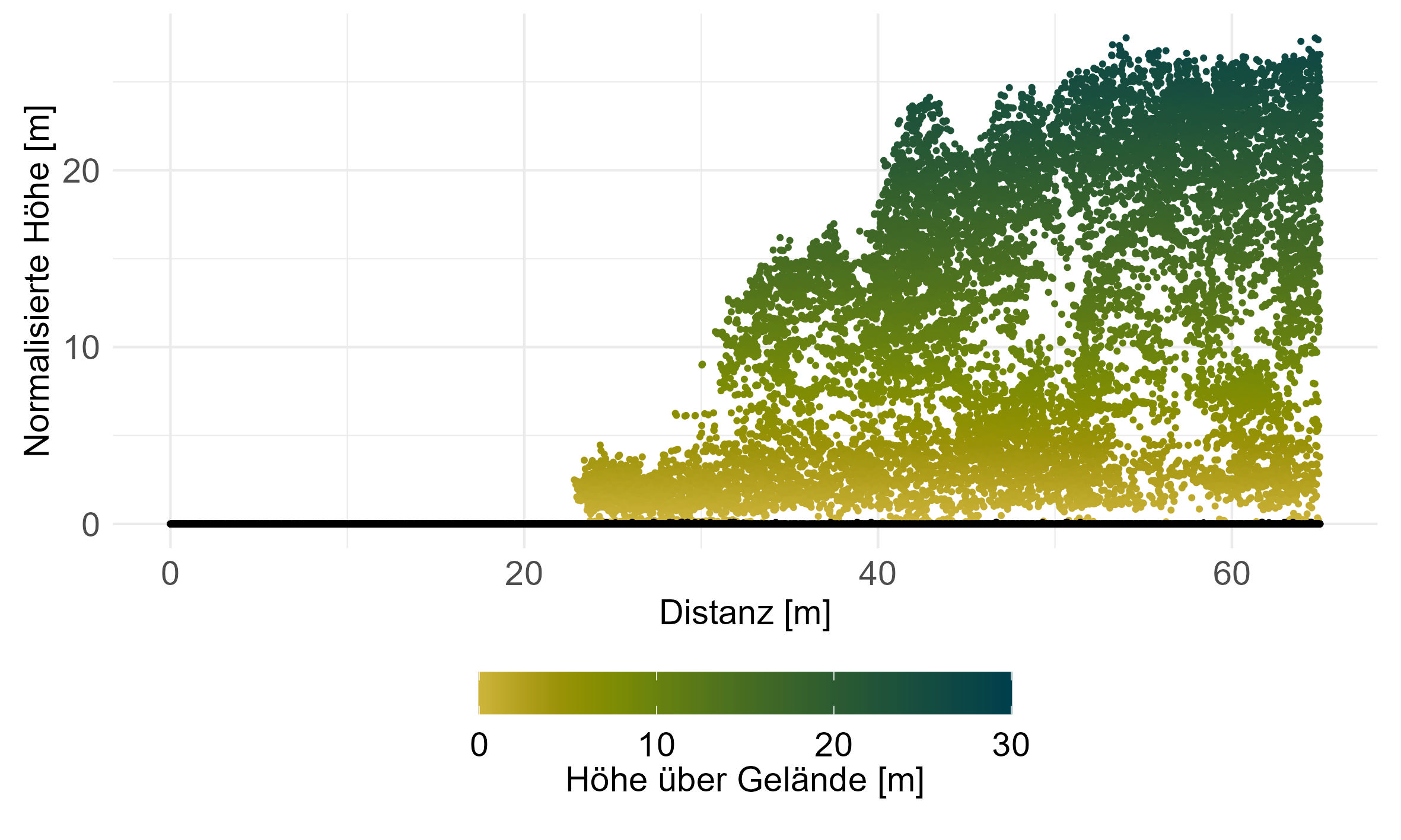
FinancingForest edges represent the transition zone between the forest interior and the open land. The ecotone value of a forest edge is determined by its structure, i.e. the composition of trees and shrubs of different heights, ages, and species. Countrywide LiDAR data provide three-dimensional information at regular temporal intervals. This data allows to derive the vegetation structure at a high level of detail. As part of the Swiss National Forest Inventory (NFI), we derive various characteristics from this data to describe the forest edge structure. These are the variability in the vegetation height model, the area ratios of the three forest edge components shrub belt (vegetation heights < 4 m), shelterbelt (4 m - 16 m) and forest (> 16 m), the light availability, the height gradient of the forest edge from the open land into the forest interior (Figure) and the density of biomass in the front of the forest edge. The characteristics were chosen such that they are interpretable and have an ecological significance for the functioning of the forest edge in the ecosystem. A forest edge area of 100 m x 60 m (along and perpendicular to the forest boundary line, respectively, according to a forest mask) serves as a reference area for calculating the characteristics. Such forest edge areas are extracted from the LiDAR data at regular intervals of 100 m along the forest boundary line. This results in a spatially explicit, area-wide forest edge description. On the one hand, this description can serve as a basis for planning forest edge restoration or management activities to preserve biodiversity. On the other hand, changes in forest edges over several years can be observed from the existing LiDAR time series.