

Natural regeneration dynamics in forests under high wild ungulate pressure, invasive neophyte colonization, and climate change
2025
FinancingThe forests of the Canton of Ticino play an essential role in protecting against natural hazards, ensuring the safety of settlements and infrastructure. However, forests are facing new challenges jeopardizing the natural regeneration: on the one hand, the expansion of invasive plant species (neophytes) are altering the structure and composition of the stands; on the other hand, the high density of wild ungulates (deer in particular), whose selective browsing alters or compromises the processes of natural regeneration.
Contents 
Several studies show how these two factors, added to the consequences of climate change (in particular summer drought), can substantially change the evolutionary trajectories of forest stands, compromising the ecosystem functionality and resilience of forests in the long term (Kupferschmid, Brang, and Bugmann 2019; Kupferschmid and Frei 2025; Gehring, Somaini, and Conedera 2025).
In order to be able to suggest effective and sustainable silvicultural recommendations and promote a constructive dialogue between the different actors in the area (foresters, hunters, naturalists, politicians), it is essential to have reliable and systematically collected long-term data about the dynamics of natural regeneration processes.
Project aims 
This project, which is the result of a collaboration between the Swiss Federal Research Institute WSL Cadenazzo, the Forest Services of the Cantons of Ticino and Graubünden and the Federal Office for the Environment (FOEN), fits into the framework of recent studies on invasive neophytes of silvicultural significance in southern Alpine forests (Rosselli and Oncelli 2023; Gehring, Pezzatti, and Conedera 2023; Gehring et al. 2024; Aranda et al. 2024).
The main objectives are:
- to create a long-term monitoring network (10-20 years) consisting of pairs of experimental plots of 16 x 16 m each, in game free conditions (antiwildlife fences) and unprotected, representative of the various forest types present in the Canton;
- to study the long-term evolution of regeneration in forest stands subject to natural or anthropogenic disturbances (e.g. silvicultural interventions, fires, drought or disease dieback), in the presence of neophytes and browsing pressure;
- to collect quantitative data on the density and composition of regeneration, browsing intensity, mortality rate, competitive dynamics between species (native and neophytes), species growth rate;
- to compare the evolutionary trajectories of stands both within fences (game exclusion) and outside, in unprotected conditions, in order to untangle the combined effects of climate change, the spread of invasive neophyte plants and the selective browsing and fraying exerted by game on young trees.
Methodology 
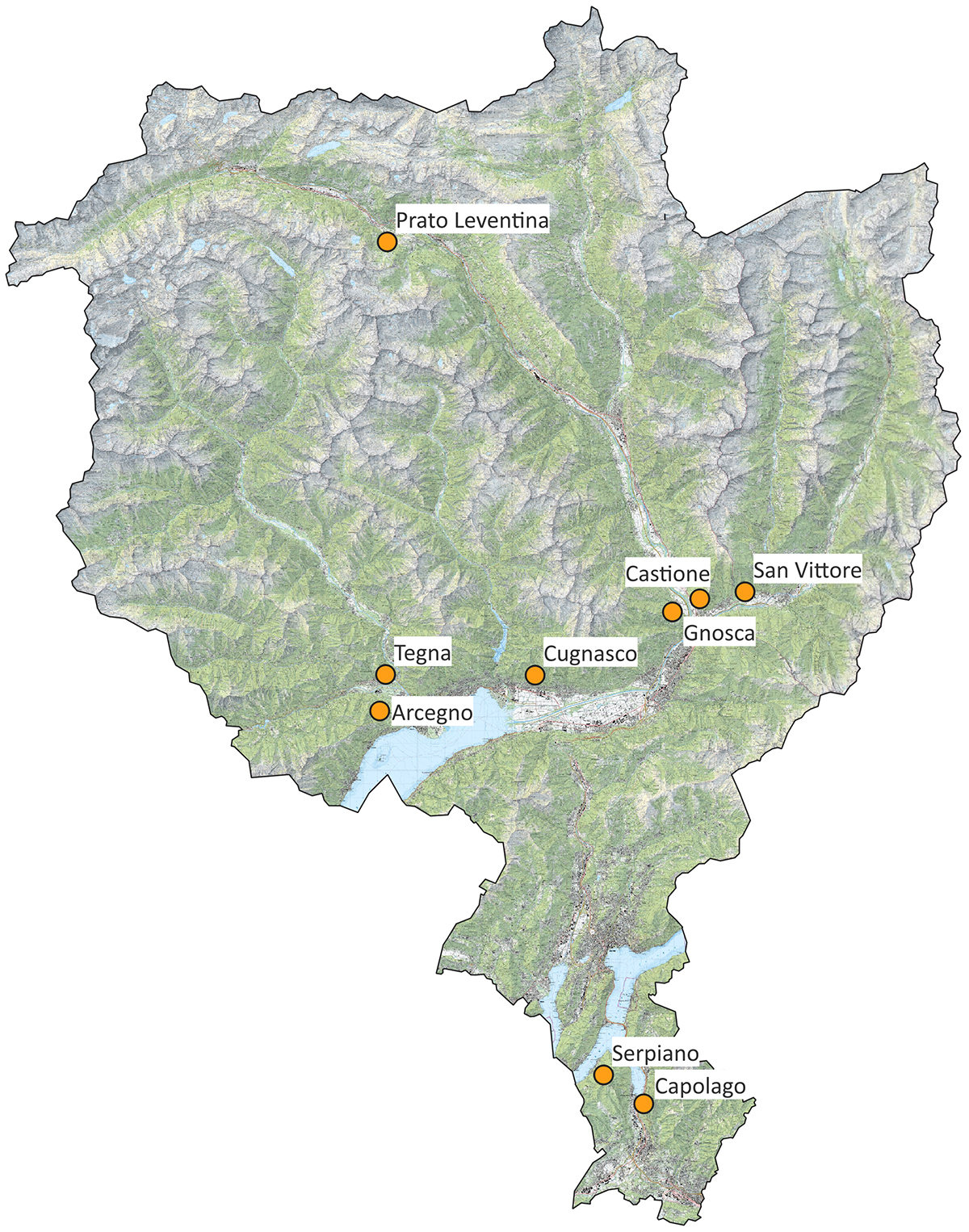
The monitoring sites were selected according to the forest types present in the canton and the presence of particularly critical conditions (presence of neophytes, poor soils, phytosanitary problems, strong pressure from game and forest management; figure 1).
Plots of 256 m² (16 × 16 m) are established at each site, in pairs (figure 2):
- one placed in the centre of a 20 x 20 m anti-ungulate fence (to minimize the border effect),
- one not fenced just beside, for direct comparison.

The surveys are carried out annually by the WSL group in Cadenazzo on the basis of the following monitoring protocol (for details see in Gehring et al. (2024):
- sampling of microstationary conditions: microtopography, vegetation cover, soil cover;
- sampling of tree individuals with h >1.3 m: species, DBH, height, wild damage, canopy transparency, tree vitality;
- sampling of regeneration with h <1.3 m: species, height, age, status (alive/dead), browsing damage.
Expected results 
The project will produce fundamental knowledge on regeneration processes in the context of South Alpine forests, providing:
- quantitative indicators of the effect of game on regeneration and its status (height, density and vitality);
- comparisons between evolutionary dynamics in the presence and absence of browsing pressure, for native species and invasive neophytes;
- useful information to model the colonization of neophytes and plan containment/integration measures;
- scientific basis to support cutting-edge forestry policies, in response to new challenges related to climate change, the expansion of neophytes and the management of wild ungulates.
References 
Aranda, Melina Jeanette, Marco Conedera, Gianni Boris Pezzatti, and Eric Gehring. 2024. “Landscape, Site and Post-Disturbance Forest Stand Characteristics Modulate the Colonisation of Non-Native Invasive Woody Species.” Forest Ecology and Management 565 (August): 122017. doi.org/10.1016/J.FORECO.2024.122017
Gehring, Eric, Marco Conedera, Gianni Boris Pezzatti, and Adrian Oncelli. 2024. “Considering Invasive Neophytes in the Promotion of Natural Regeneration for the Long-Term Conservation of Forest Functions in the Swiss Southern Alps.”
Gehring, Eric, Gianni Boris Pezzatti, and Marco Conedera. 2023. “Where and How to Prevent or Integrate Silvicultural Relevant Invasive Neophytes. Final Report, BAFU, 00.5053.PZ/1DED6F390.” Cadenazzo.
Gehring, Eric, Zeno Somaini, and Marco Conedera. 2025. “Schutzzäune Belegen Tiefgreifende Wildeinflüsse Auf Die Verjüngung Der Kastanienwälder.” Schweizerische Zeitschrift Für Forstwesen 176 (1): 40–43. doi.org/10.3188/szf.2025.0xxx
Kupferschmid, Andrea D., Peter Brang, and Harald Bugmann. 2019. “Assessment of the Impact of Ungulate Browsing on Tree Regeneration.” Schweizerische Zeitschrift Fur Forstwesen 170 (3): 125–34. doi.org/10.3188/szf.2019.0125
Kupferschmid, Andrea D, and Esther R Frei. 2025. “Einfluss Des Verbisses Auf Die Baumverjüngung in Der Schweiz: Überblick Basierend Auf Kantonalen Daten.” Schweizerische Zeitschrift Für Forstwesen 176: 146–57. doi.org/10.3188/szf.2025.0146
Rosselli, Andrina, and Adrian Oncelli. 2023. “Umgang Mit Invasiven Neophyten Zur Langfristigen Erhaltung Der Waldfunktionen.” Foglio per La Pratica, Versione V1.0, Sezione Forestale Cantonale, Bellinzona, 25.