

Sufficiency Policy in Rural Municipalities
2021 - 2025
Financing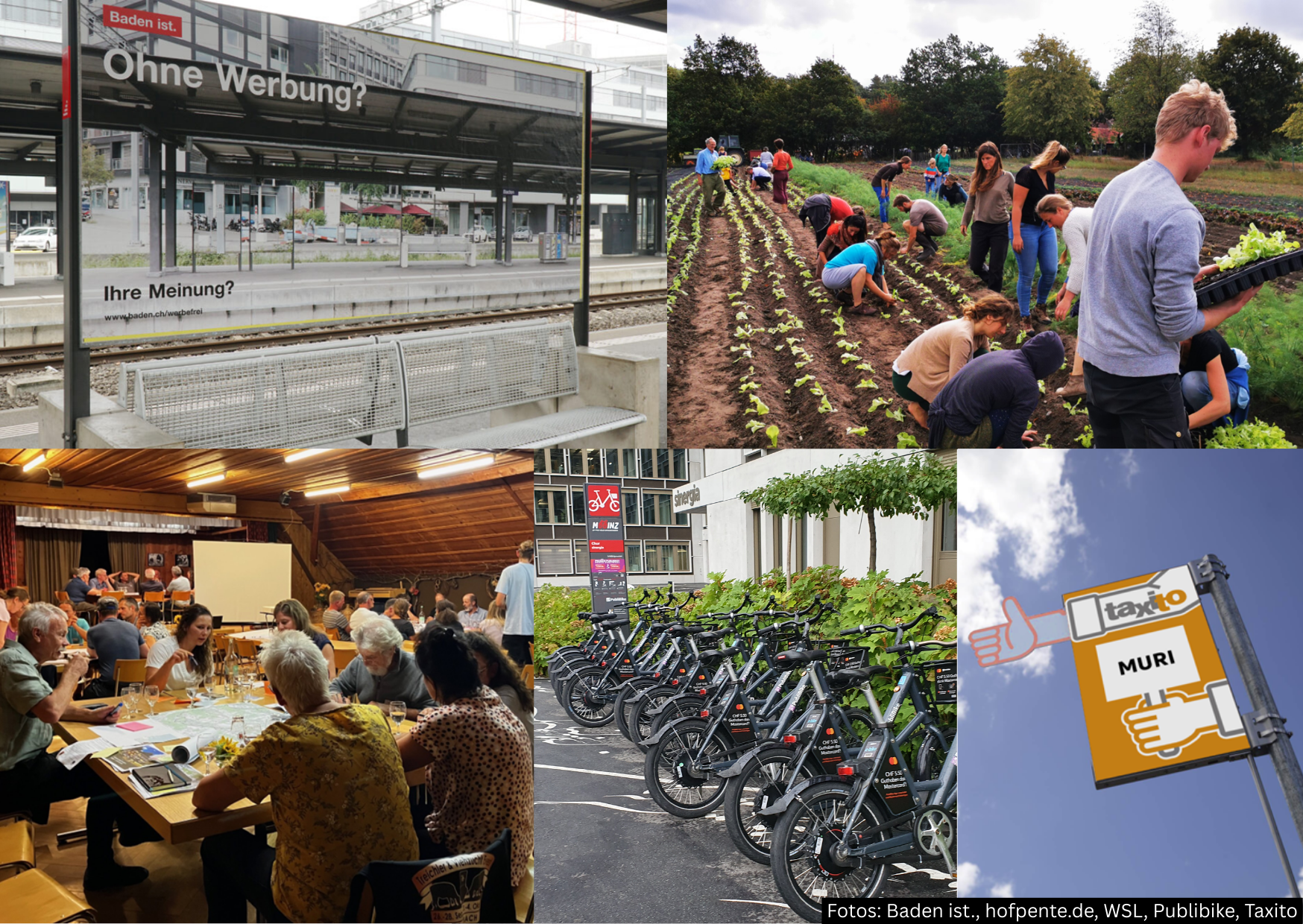
The project analyzes how rural communities in Switzerland can become self-sufficient and contribute to sustainable development. With a focus on rural regions, it examines the potential for sufficiency policies in communities, the factors that promote and inhibit them, and how the federal government and cantons can support communities in developing and implementing sufficiency policies. In the practical part of the project, selected communities are supported in implementing sufficiency measures, sufficiency-oriented governance instruments are developed, and proven examples of sufficiency are prepared and publicized.
Background
Global production and consumption patterns are unsustainable because they exceed planetary boundaries. Sufficiency strategies aim to change resource-intensive consumption and production behaviors so that social needs can be met in a resource-efficient, local, and socially acceptable manner. Although more and more people are trying to live sufficiently, individuals can only advance the transformation to greater sustainability to a very limited extent, as there is a lack of political framework conditions that promote sufficient lifestyles and favor alternative consumption and production patterns. Sufficiency policies address this issue and aim to achieve resource-conserving and socially acceptable consumption and production patterns in all sectors through supportive and binding political measures. This project analyzes sufficiency policies in rural communities through a research component and a practical component.
Research component
The methodological basis for the research component consists of systematic literature reviews, surveys in rural communities, expert interviews, and a representative, nationwide online survey. Three scientific publications examine the following questions:
- How can sufficiency policies be conceptualized and defined at the community level?
- What sufficiency measures exist at the community level, in the literature, and in practice?
- What factors promote or inhibit the implementation of sufficiency policies in communities?
- What is the level of acceptance of sufficiency measures among the Swiss population?
In addition to the scientific publications, a comprehensive list of sufficiency measures identified in literature and practice, as well as “examples of proven sufficiency measures” in Swiss municipalities, will be compiled and published.
Practical Component
In the practical part, selected Swiss municipalities are supported in implementing sufficiency measures and sufficiency-oriented governance instruments are developed.
- Supporting municipalities in implementing sufficiency measures:
In a three-stage support process, the municipality's needs and challenges are first identified, then sufficient solutions for the identified needs are sought in a participatory and co-creative manner, and finally their concrete implementation is initiated. Further information on the support services for municipalities can be found here. - Sufficiency-oriented governance instruments:
1. Collaboration with the finance directors of several Lucerne municipalities has resulted in a concept paper that presents how participatory and sufficient municipal financial planning could work.
2. A policy brief is being developed to outline how the New Regional Policy (NRP) instrument could be designed in the future to actively promote sufficiency in municipalities.
Examples of proven sufficiency projects and measures
- Wie Gemeinden Suffizienz fördern können (in German)
This comprehensive database and a number of detailed measure profiles provide good examples that serve as inspiration and guidance for municipalities that want to become more sufficient. - Proven sufficiency projects and measures in five sectors (in German)
This presentation provides an overview of around 30 proven sufficiency projects and measures in five different sectors that can be replicated, supported, and scaled up. - VHS course on sufficiency in neighborhoods and communities (in German)
This presentation introduces the concept of sufficiency, highlights its necessity, describes the interaction between individuals, neighborhoods, and politics in the implementation of sufficiency measures, and provides an overview of around 30 proven sufficiency projects and measures in five different sectors.
Scientific Articles
Iten T., Seidl I., Pütz M. (2024) Sufficiency policy: a definition, conceptual framework, and application to municipalities. Sustain. Sci. 19, 1709-1734. doi:10.1007/s11625-024-01534-1
Iten T., Seidl I., Pütz M. (2025) Sufficiency Policy in Rural Municipalities: Measures, Enablers, and Barriers. Env. Pol. Gov. 0, 1–23 doi:10.1002/eet.70027
Further Publications
Pütz M. und Kusma S. (2025) Wie ländliche Gemeinden zum Schutz natürlicher Ressourcen beitragen können. Medienmitteilung vom 29.10.2025 auf wsl.ch und stiftung-mercator.ch.
Iten T. and Müller A. (2025) Creating living space, saving space: sufficiency in concrete terms. Media release dated 6 November 2025 on schweizer-gemeinde.ch.