and external scientific reporting, management processes and tools, indicators/key figures WSL, forecasting science, project office, research funding Environment and Safety ¶ Environmental management, o
they develop, and how people can protect themselves, e.g. through spatial planning, reliable forecasting or technical protective measures. Thereby we lay the scientific foundations for risk analysis and
study polar snow and how it "ages". These findings help to reconstruct past climate and improve forecasts. Permafrost The SLF permafrost monitoring network provides information on the condition of permafrost
Glide-snow avalanches are considered unpredictable. It is presently unclear, where the water at the snow-soil interface comes from. By linking the two porous media, snow and soil, and assessing the mass and heat exchange across their interface, we will advance the predictability of glide avalanches.
The data for avalanche forecasting need to be accessible in high quality as soon as these become available. Any measurement errors, anomalies and data gaps diminish forecast accuracy. We aim to develop algorithms for real-time data cleansing by applying state-of-the-art machine learning approaches.
Climate change exacerbates drought-related extremes, with significant ecological, economic, and human health impacts. MaLeFiX project is developing an interdisciplinary platform that will provide comprehensive four-week forecasts of drought-related extremes – buying stakeholders valuable time to act.
The best avalanche forecasts are worth little if users are unable to understand and apply the provided information in their risk management practices. While it is well established in the risk communication community that an in-depth understanding of the needs and skills of the target audience is critical for effective communication, avalanche safety research has traditionally focused mainly on improving the accuracy of avalanche forecasts and did not pay much attention to how the information is interpreted and applied
About influencers, super-forecasters, group discussions, and majority voting in avalanche forecasting at SLF.
The main objective of SnowInflow is to reduce errors in inflow forecasts for hydropower producers during the critical snowmelt period. SLF will contribute with improved physics-based snow models and associated data assimilation schemes.
Anna Haberkorn, SLF avalanche forecaster since early 2025, shares her induction experience and future hopes in a video.
SLF researchers optimize snowmelt models with satellite data. These advances are important for more precise flood warnings.
Snowmelt in forests is difficult to calculate, but thanks to innovative measuring systems and modelling, this can now be done more effectively.
The avalanche warning services operating in Europe have undertaken to develop common standards for their activities. Their General Assembly recently adopted a resolution to revise the designations of avalanche sizes.
neural networks to use the dendrometer signals and the available metadata as input to infer and forecast stem growth properties. Aline Bornand: Using deep learning to predict the shape of tree crowns from [...] incorporation of accurate soil information into SDMs becomes indispensable for making well-informed forecasts for guiding decisions in forest management, also when addressing the potential distribution shifts
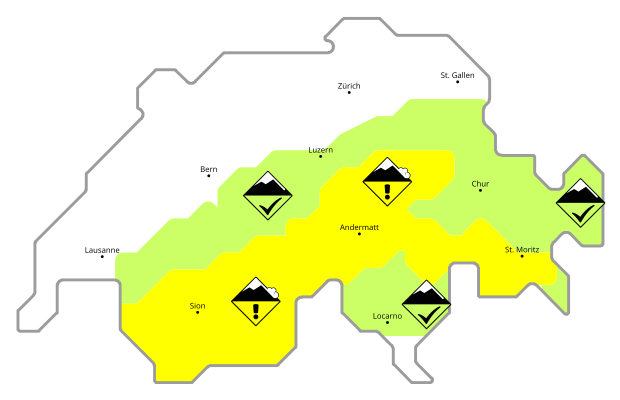
Increasingly sophisticated algorithms have already become part of our lives. This development is also starting to extend to avalanche forecasting. It is starting to impact our work as forecasters and will eventually also influence our forecast products.
The operational model chain at SLF now encompasses the physical snow-cover model SNOWPACK but also recently developed machine-learning models. These models deliver predictions on various aspects relevant to regional avalanche forecasting, such as the likelihood of dry-snow or wet-snow avalanches in a region, snowpack instability, and the danger level. Taking the perspective of the avalanche forecaster, I will share examples to underscore the potential advantages and challenges associated with utilizing these models in operational avalanche forecasting at SLF.
Snow temperature forecasts will help prepare cross-country skis for optimal performance.
Progress for avalanche forecasting: New experimental method shows how fractures spread in weak layers in the snow.
The PROSNOW project aims to provide meteorological and climatological forecasts to optimise snow management in ski resorts.
Slab avalanches cause the highest number of fatalities each year. Researches are now smoothing the way for more effective risk forecasts.
The SLF avalanche forecaster Benjamin Zweifel filed this report after spending two weeks with the avalanche warning service in Scotland.
SLF researchers investigate in deep holes whether satellite data accurately show snowmelt to improve hydrological discharge forecasts.
WSL develops and operates a probabilistic flood forecasting system for the pre-alpine catchment of the river Sihl. Floods can be detected early through a series of daily performed predictions.
The goal of this project is to take advantage of recently developed avalanche models and detection systems to setup a model framework for avalanche forecasting in Switzerland and to assess changes and uncertainties in avalanche hazard due to climate change.
How do light, temperature, and water drive the timing of leaf senescence? By merging experiments, long-term observations, carbon-flux data, and satellite records, this project will create a next-generation model to forecast autumn phenology and growing season length in a warming world.