

We research debris flows by observing the flow properties of naturally-occurring debris flows mainly at the Illgraben field site. Observations include flow depth, basal forces, and velocity. Special measurement campaigns focus on measuring additional flow properties and to test novel sensors.
Contents 
Understanding processes through field observation 
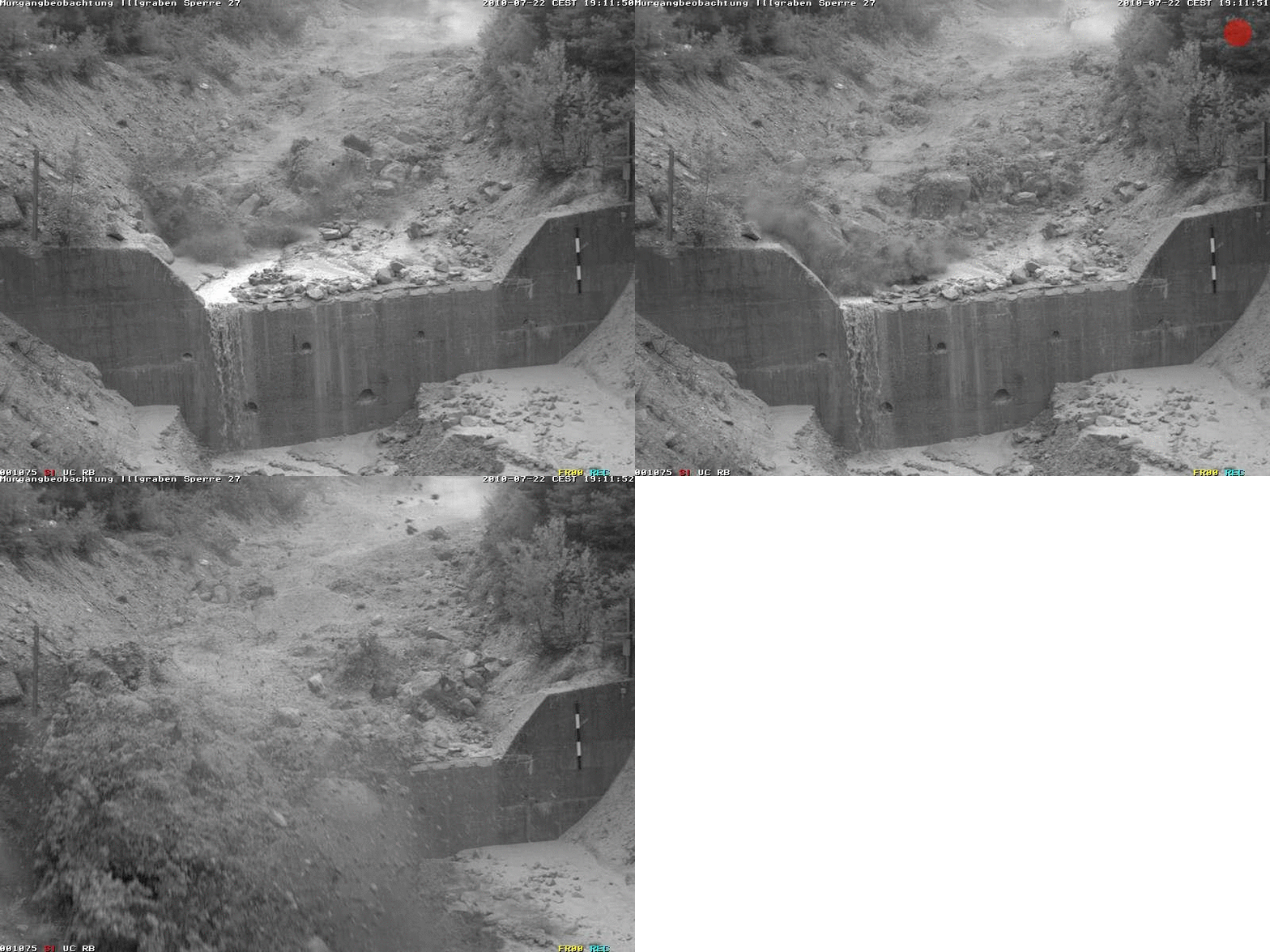
We have installed several debris flow stations in the Swiss Alps which provide us with unique data sets to enhance our understanding of triggering and flow processes. Additionally, they provide an opportunity to test numerical models of debris-flow behavior for use in practical applications and to provide a basis for developing and testing new debris-flow early-warning systems.
A debris-flow monitoring station is currently in operation at Illgraben. Other stations were operated previously at Dorfbach (Randa), Schipfenbach (Preonzo), and Riasc (Olivone).
Debris flows at Illgraben occur several times a year, making the site useful for research. WSL has installed instrumentation in the catchment and along the channel to allow measurement of flow depth, flow velocity, mass density. The data serve as a basis to better understand the debris flow process, with special measurement campaigns to measure e.g. channel-bed erosion, the flow speed on top and bottom surfaces of the flow, and the generation and speed of individual surges within debris-flow events.


Laboratory Experiments 
At WSL’s laboratory we study aspects of debris-flow behavior or test the performance of sensors when we have a specific research question requiring laboratory precision, e.g. Rickenmann et al., 2019 https://www.dora.lib4ri.ch/wsl/islandora/object/wsl%3A21073
Runout Modelling 
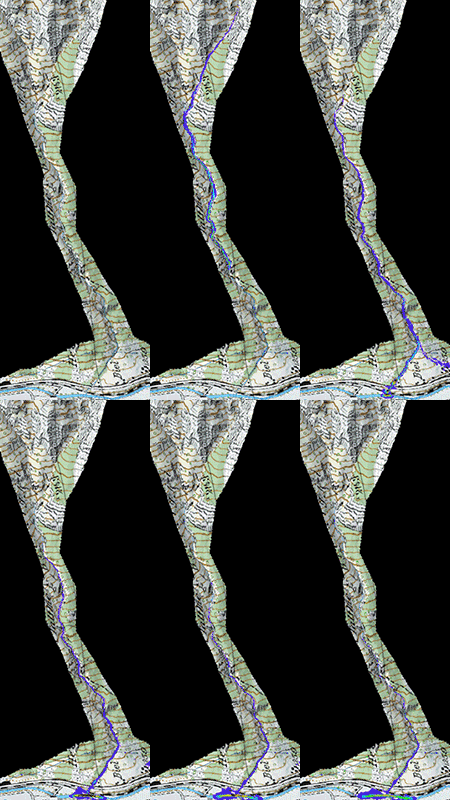
The group has also contributed to the development and testing of models used to poredict the runout and erosion resulting from debris flows, mainly using the RAMMS model. In 2024 RAMMS was transformed into a spinoff company, RAMMS AG, although RAMMS continues to be used by WSL staff for teaching, consulting, as well as research (e.g. Bolliger et al., 2024 https://www.dora.lib4ri.ch/wsl/item/wsl:36479.
Applications 
The results from our research expand on the knowledge of the complex and still insufficiently known phenomena of debris flows. The combination of experience with field observation, numerical modelling, and laboratory experiments can also contribute to improve methods and procedures used to assess natural hazards and assess the performance of protective measures.
Short video about WSL research in the Illgraben (Gottardo Pestalozzi, WSL)
Contact 
Publications 
Projects 
WSL strategic initiative: Climate Change Impacts on Alpine Mass Movements (CCAMM)
Past projects:
- TRAMM2 - Triggering of rapid mass movements
- EU-Projekt "T.HA.R.MI.T": Torrent hazard control in the European alps, practical tools and methodologies for hazard assessment and risk mitigation
- Swiss Virtual Campus Projekt "Dealing with Natural Hazards and Risks". 3rd International Conference on Debris Flow Hazards Mitigtation Mechanics, Prediction, and Assessment 2003 in Davos, Switzerland - Proceedings