

17.11.2026 | WSL communication | WSL News
The extent to which trees suffer from drought depends on the availability of water in the soil and in the air. Four new studies by the Swiss Federal Institute for Forest, Snow and Landscape Research (WSL) show that, in the case of Scots pines, air dryness influences how they utilise soil water. For beech trees, soil dryness is the primary factor determining mortality.
- Scots pines: When the air is more humid, Scots pines keep their stomata open for longer. As a result, they consume soil water more quickly under dry soil conditions than they do when the air is dry.
- Beech trees: Ten years of measurements across eight sites in Switzerland reveal which level of soil dryness significantly increases the risk of tree mortality. Dry air has mostly an indirect effect on tree mortality.
- The findings from the four studies will help predict how forests change under increasing dryness – for instance, in forest development models.
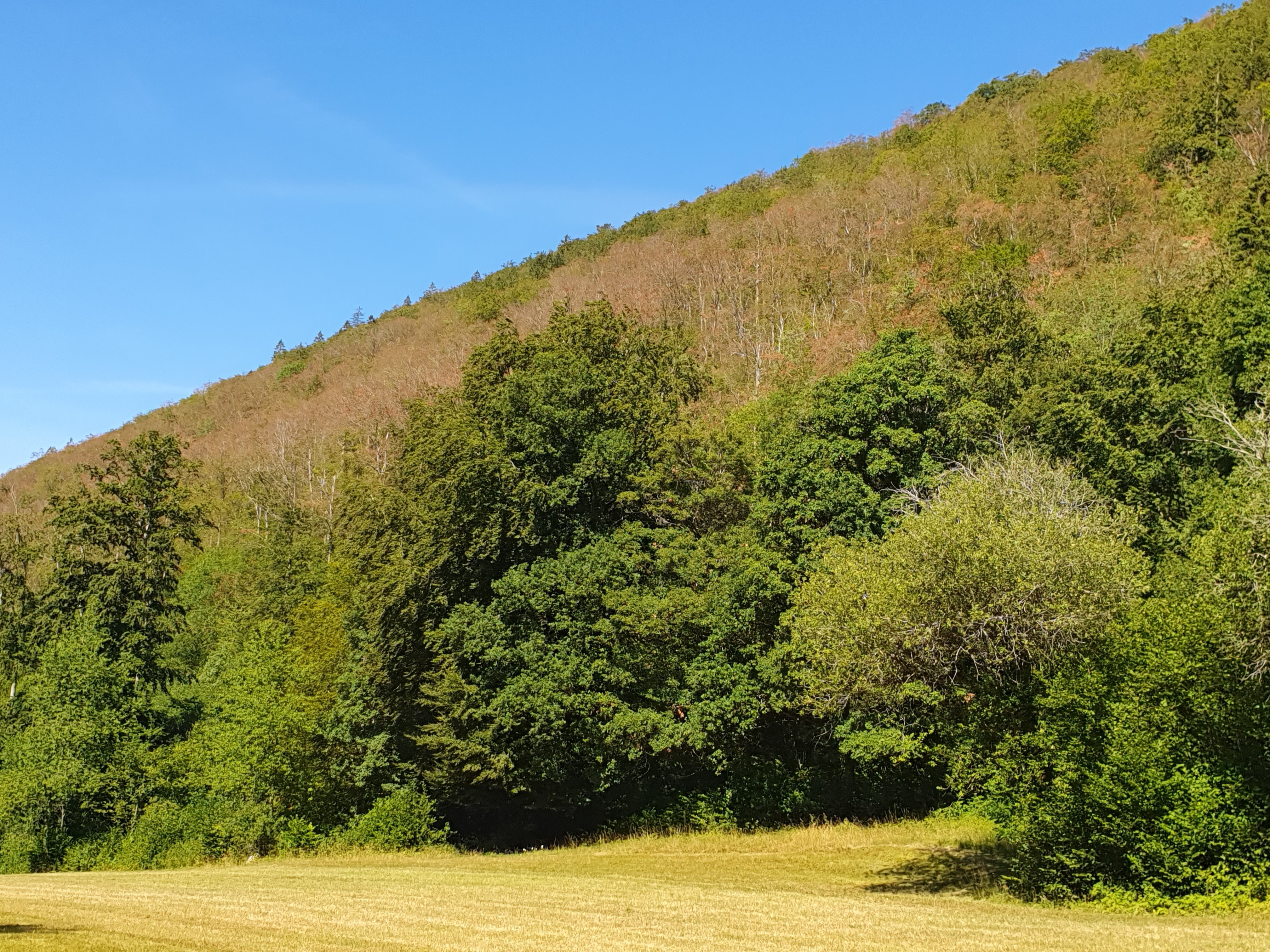
Global warming is making the air ‘thirstier’ and causing the soil to dry out more frequently and more severely. What does this mean for forest trees? And at what point does it become life-threatening for them? Four new studies by the Swiss Federal Institute for Forest, Snow and Landscape Research (WSL) shed light on these questions from two different perspectives. Three are based on an experiment conducted in a 130-year-old pine forest in Pfynwald (Valais), while the fourth draws on ten years of measurements in beech forests at eight sites across Switzerland. Together, the results provide complementary insights into the different types of drought stress and thresholds for these two tree species.
Scots pines: mist in Pfynwald 
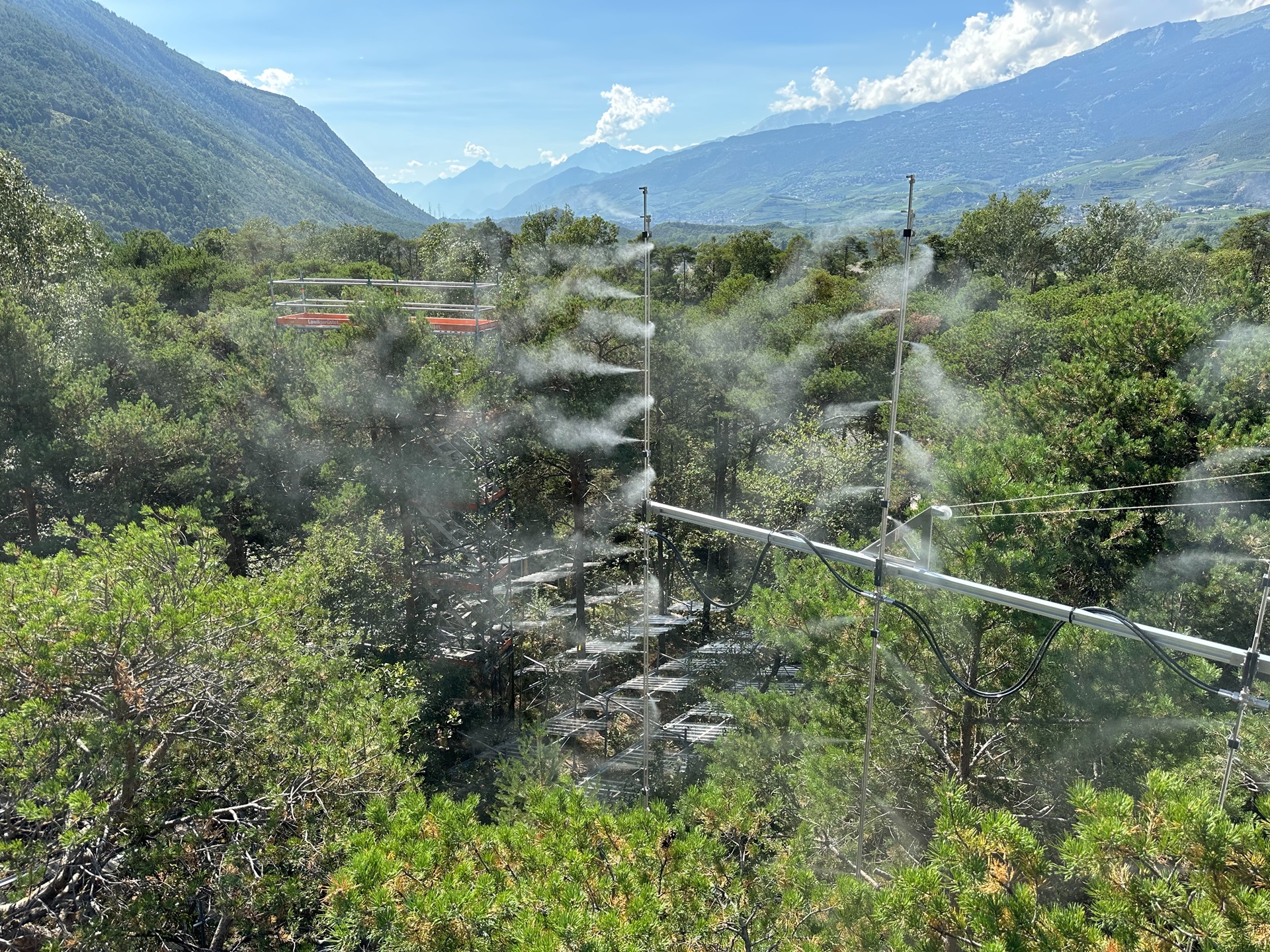
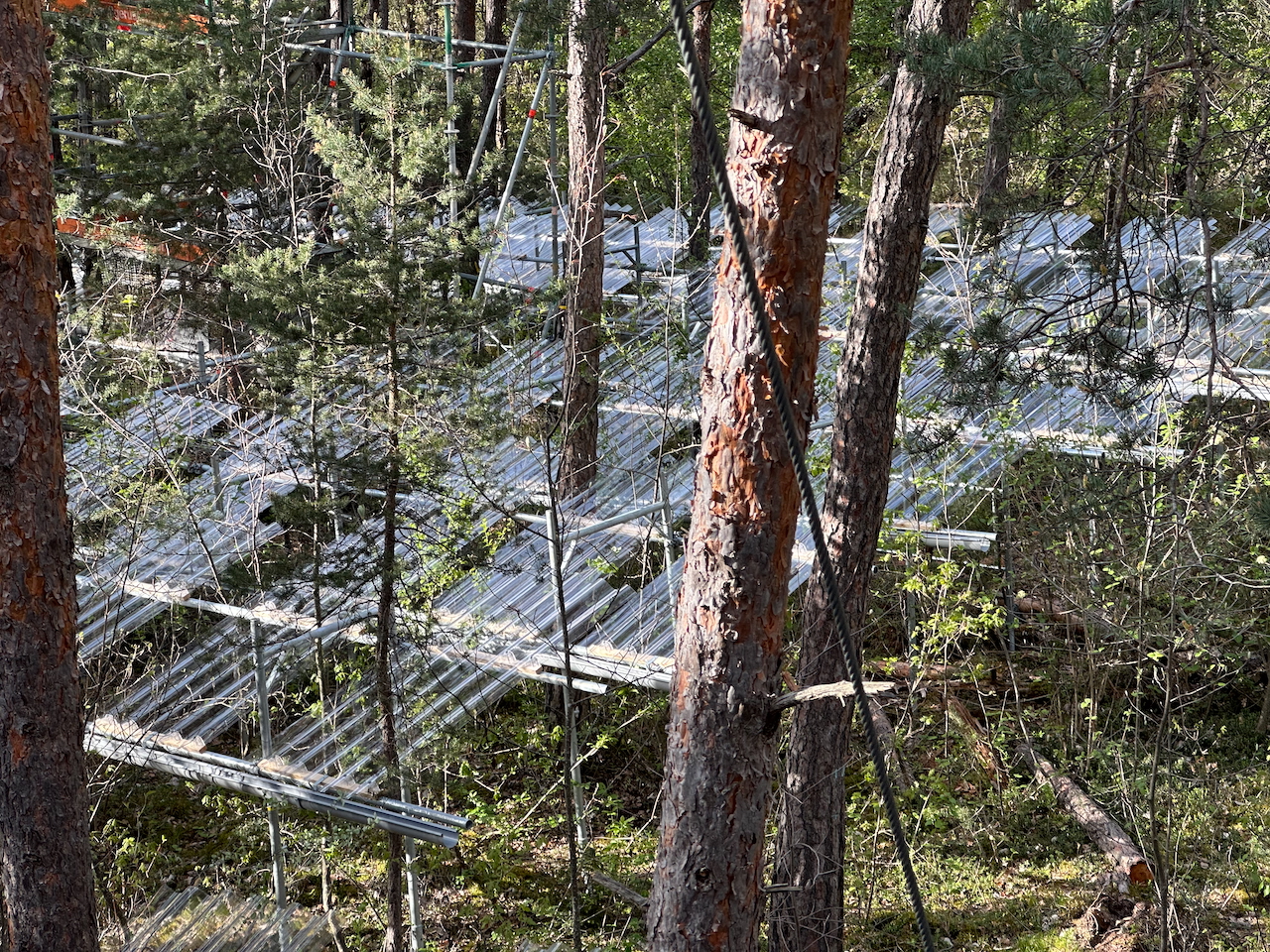
The Scots pines in the forest of Pfynwald have been declining in health for decades. There, WSL has been irrigating experimental plots since 2003 to investigate the effects of drought. More recently, researchers have also been altering air humidity: nozzles spray a fine mist of water, which humidifies and cools the air in the canopies. On some plots, plastic roofs keep half the rainfall off the ground.
“With this experimental setup, researchers can separately investigate the effects of dry air and dry soil in a natural Scots pine forest for the first time”, explains WSL project leader Marcus Schaub.
A first study shows how dry air can accelerate soil drying through the plant: on particularly hot and dry days, the spray reduces the so-called vapour pressure deficit (VPD) by around a fifth. This measures how much water vapour the air can still absorb. The higher the VPD, the more the air drives water loss from the trees. However, trees can limit this water loss by closing their stomata – tiny pores in their leaves or needles through which they also absorb carbon dioxide (CO₂). With sunlight, they convert CO₂ and water into sugar.
Die of thirst or starve?
Trees faces a dilemma: closing their stomata reduces water loss, but limits their sugar production. “The tree constantly has to decide: do I die of thirst or starve?” explains Schaub.
A second study led by Giovanni Bortolami (EPFL and WSL) shows that how much water a tree consumes depends both on air humidity and on how widely its stomata are open.
In well-watered Scots pines, more humid air had no statistically significant effect on the water consumption of the tree. However, the pines reacted differently when the soil was dry: in drier air, they closed their stomata earlier. In humidified air, they kept them open even when the soil had already dried out considerably. As a result, they consumed more soil water, depleting their reserves more rapidly.
In the experiment, the pines used their available water more sparingly in dry soil conditions, even when the air was dry. The effect of air humidity on water consumption cannot therefore be deduced from air humidity alone.
Water reserves in the tree trunk
A third study led by Richard Peters (Technical University of Munich and WSL) demonstrates the importance of the water stored in the trunk. When the soil is dry, up to 55% of the water evaporated daily comes from this reserve, compared with around 10% when water is readily available. This is mainly because the tree evaporates less water overall during dry periods but continues to draw on stored water.
Night-time conditions are also crucial: this is when Scots pines replenish their reserves. However, when the air remains dry at night and the soil is already somewhat drier, they are less able to do so.
Beech: The soil determines when trees die 
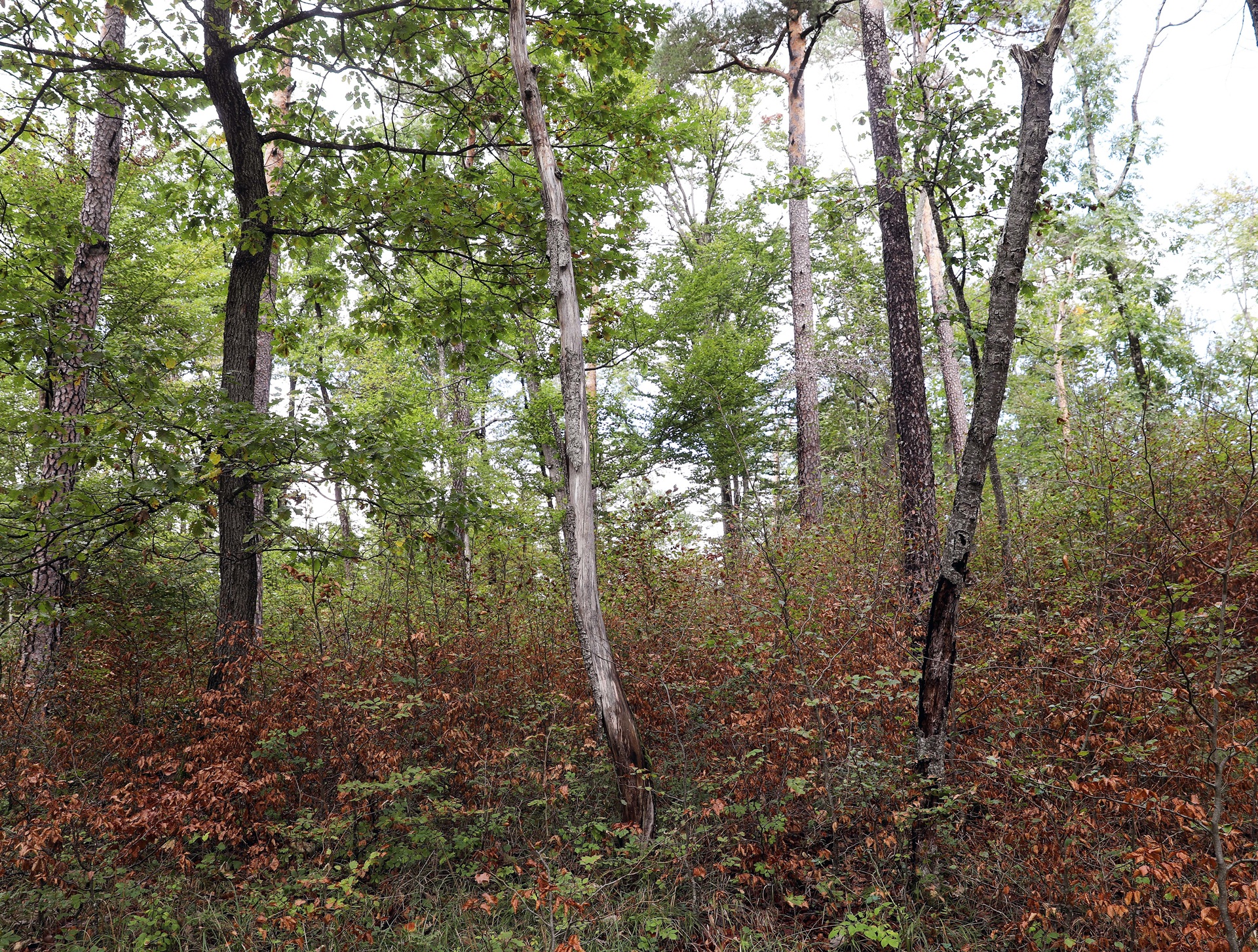
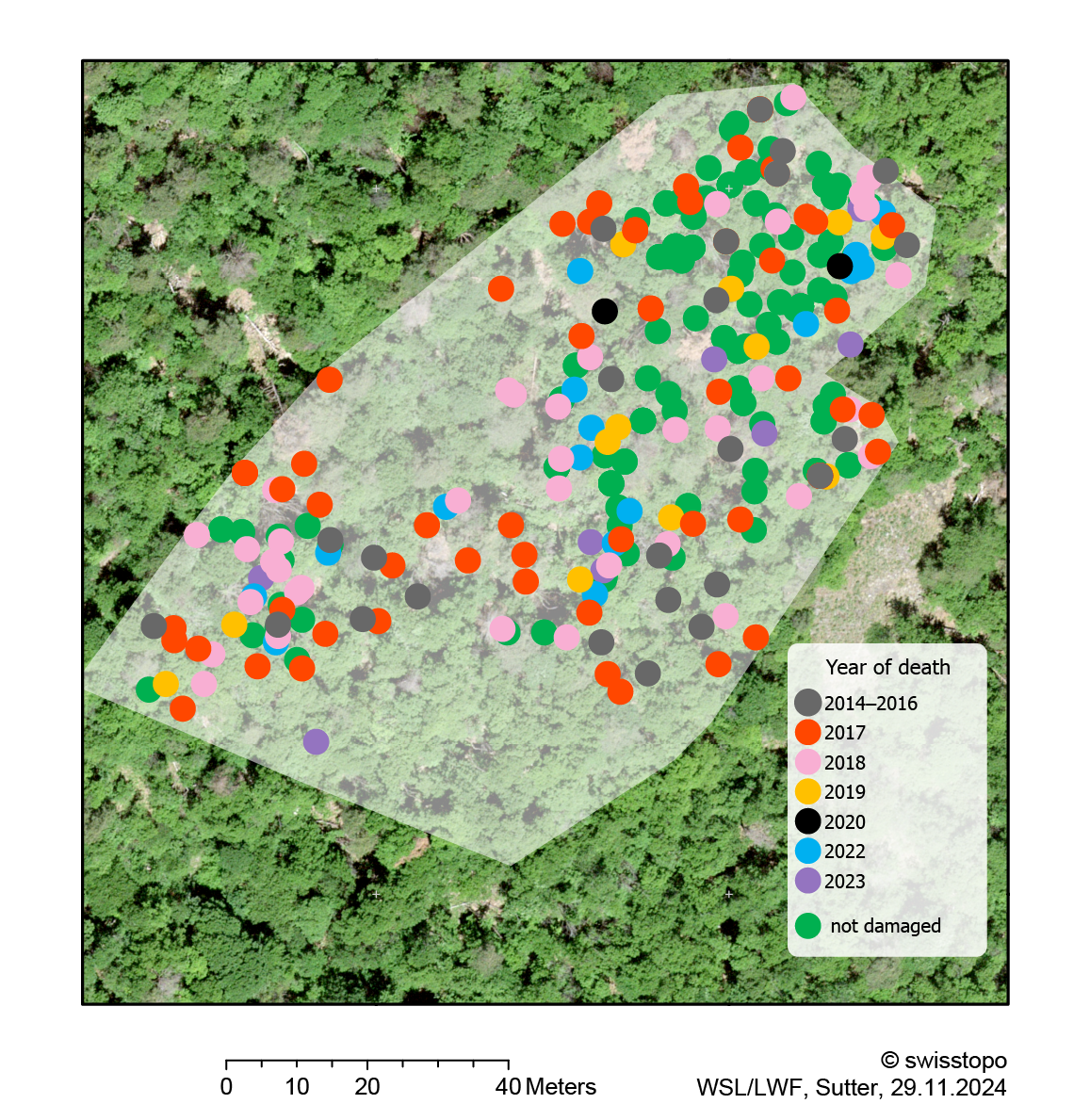
Unlike the studies on pine trees, the fourth study is not based on experiments, but on long-term measurements in natural beech forests in Switzerland. For several years now, drought damage in this species has been on the rise: leaves turn brown in the middle of summer, and branches or entire trees die off. But at which level does drought become life-threatening?
WSL researchers investigated water availability and beech tree mortality at eight sites across Switzerland between 2014 and 2023. Their key finding: the decisive factors are how dry the soil in the root zone is and how long the drought lasts.
For the first time, the researchers were able to determine a critical threshold. It corresponds to an average soil water potential in the root zone of approximately minus 0.8 megapascals. This value describes how strongly water is held in the soil. The more negative it becomes, the more difficult it is for the roots to absorb water. At this threshold, water uptake practically stops. The beech trees then largely close their stomata to conserve water.
‘Exceeding this threshold does not mean that all beech trees will die. Rather, the risk of mortality increases significantly at this value, particularly if the drought persists for a long time,’ explains lead author Lorenz Walthert, a soil and site specialist at WSL.
The Saillon site in Valais illustrates how severe the consequences can be. Of the 312 beech trees monitored, 48 % died between 2014 and 2023. During the drought years of 2017, 2018 and 2022, annual mortality rate was between 12 and 17%. In contrast, hardly any trees died during the wetter years of 2020 and 2021. Both young and mature beech trees were affected.
Dry air affects the soil
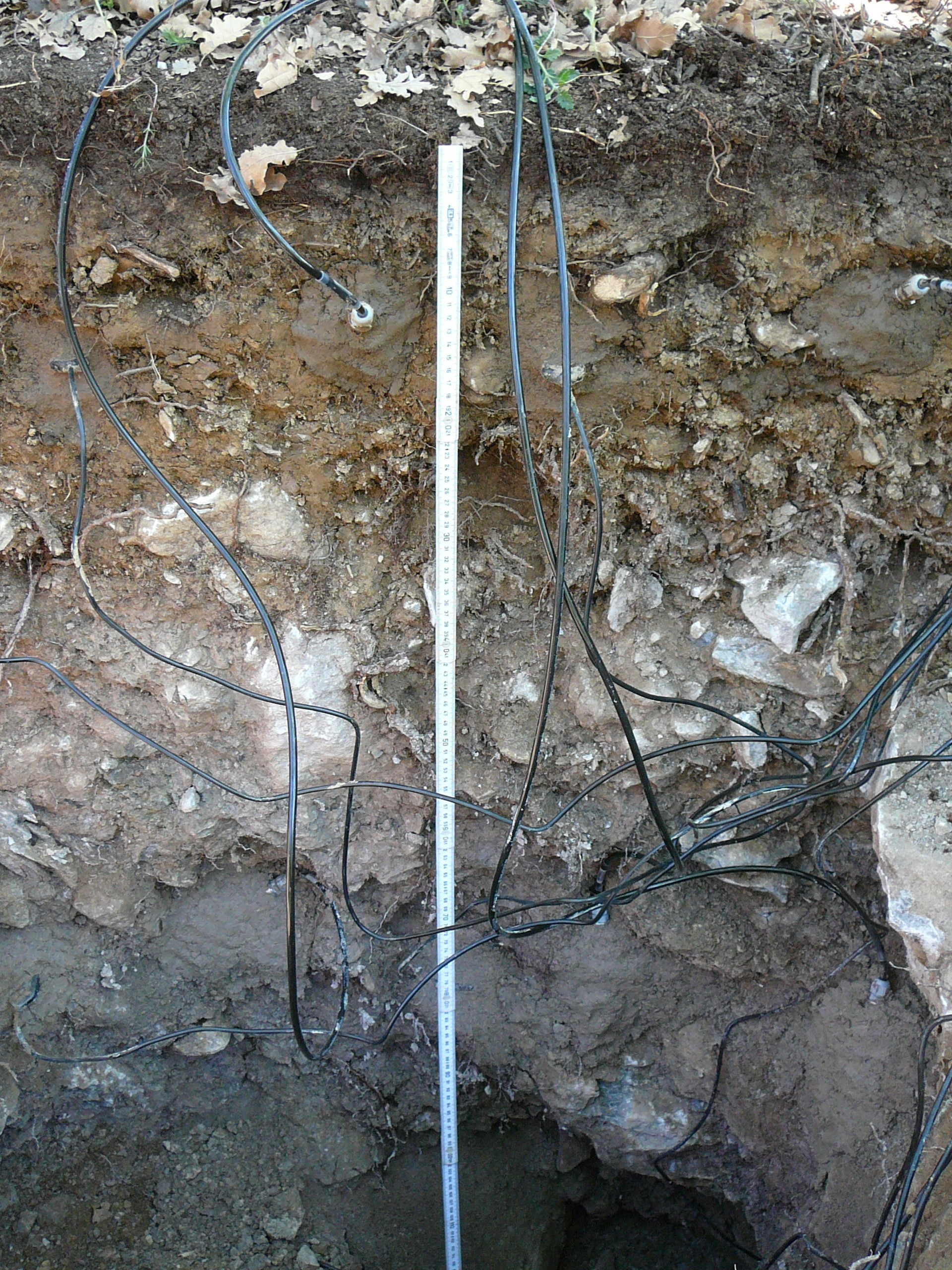
The researchers found no evidence of a direct influence of dry air, heat or strong sunlight on beech mortality. However, dry air indirectly exacerbates soil drought by increasing evaporation and the trees’ water consumption. Furthermore, beech trees bud earlier when spring temperatures are higher and thus begin drawing water from the soil earlier in the year.
‘We were surprised to find that beech trees die off even on deep soils with a high water-storage capacity,’ says Walthert. The decisive factor here is whether water reserves are replenished during the winter. At Saillon, this only happened completely once during the ten-year study period. As a result, in most years the beech trees lacked vital reserves for the summer.
Two species, two perspectives 
The studies examine the effects of drought in two ways: through an experiment on Scots pines in Valais and through long-term measurements in beech forests across Switzerland. The Scots pine experiment shows how air humidity and soil water influence the trees’ water consumption. The beech study identifies when a lack of soil water becomes life-threatening.
Together, the studies show that air and soil drought must be considered in tandem. In beech trees, dry air increases water consumption and thus depletes soil water reserves more quickly. In the pine experiment, more humid air combined with dry soil leads to higher water consumption: the trees keep their stomata open for longer and dry out the soil more quickly.
‘During drought, air and soil are two sides of the same coin,’ says Arthur Gessler, head of the Forest and Soil Ecology Research Unit at WSL. ‘Dry air increases evaporation, but trees can regulate their water consumption via their stomata.’ During severe drought, however, soil water availability determines life or death, while air dryness plays only a minor role.
As global warming progresses, critical droughts are likely to occur more frequently and last longer. Beech trees are particularly at risk on shallow soils in warm regions with low rainfall, but also on deep soils. If beech trees die off, more drought-tolerant species such as oaks or lime trees can take their place. The decline of Scots pines in Valais, which has been ongoing for decades, is also expected to continue, with oaks increasingly taking their place. Drought therefore changes, in the long term, the species composition of forests and the services they provide.
Studies like these help scientists better predict such changes, for example through computer simulations of forest development. “To understand how trees respond to climate change and drought, the simulations must take both air and soil dryness into account,” says Schaub. Walthert adds: “To assess the risk of tree mortality, we should consider not only climate data, but also the properties of forest soils and how their water reserves change over time.”
Research methods
1) Scots pines – experiment in the Pfynwald forest
In a forest of Scots pines of around 130 years old in Pfynwald (Valais), WSL is investigating how dry air and dry soil interact. Since 2003, researchers have been irrigating part of the experimental plots. From 2024, they have also been humidifying the air in the tree canopies using fine spray nozzles. On other plots, plastic canopies keep around half of the precipitation off the ground. This allows the researchers to vary air humidity and water supply to the soil independently. More on the project: VPDrought
2) Beech – ten years of measurements
Between 2014 and 2023, the WSL studied beech trees at eight forest sites in Switzerland, some of which were part of the TreeNet project, including three in Valais. Every hour, sensors recorded data on water availability at various soil depths. The researchers also monitored which trees died. The sites differ in their climate and in how much water their soils can store. Unlike in Pfynwald, the researchers did not alter the natural conditions.
Contact 
Publications 
Projects 
Copyright 
WSL and SLF provide image and sound material free of charge for use in the context of press contributions in connection with this media release. The transfer of this material to image, sound and/or video databases and the sale of the material by third parties are not permitted.