

02.03.2026 | WSL News
In many Swiss forests, too few young trees are growing – and many of those that do are not adapted to future climatic conditions. Several projects at the Swiss Federal Institute for Forest, Snow and Landscape Research WSL are investigating the causes. The researchers are now presenting their findings in a special issue of the Swiss Forestry Journal (SZF).
- Many Swiss forests have too few young trees – or the species that do grow are not suited to a future with a warmer and drier climate.
- Many deciduous tree species are growing in forests on the northern side of the Alps. In the central Alps, where conifers dominate, and on the southern side of the Alps, regeneration is significantly lower.
- WSL research highlights ways in which forests can be adapted to ongoing climate change.
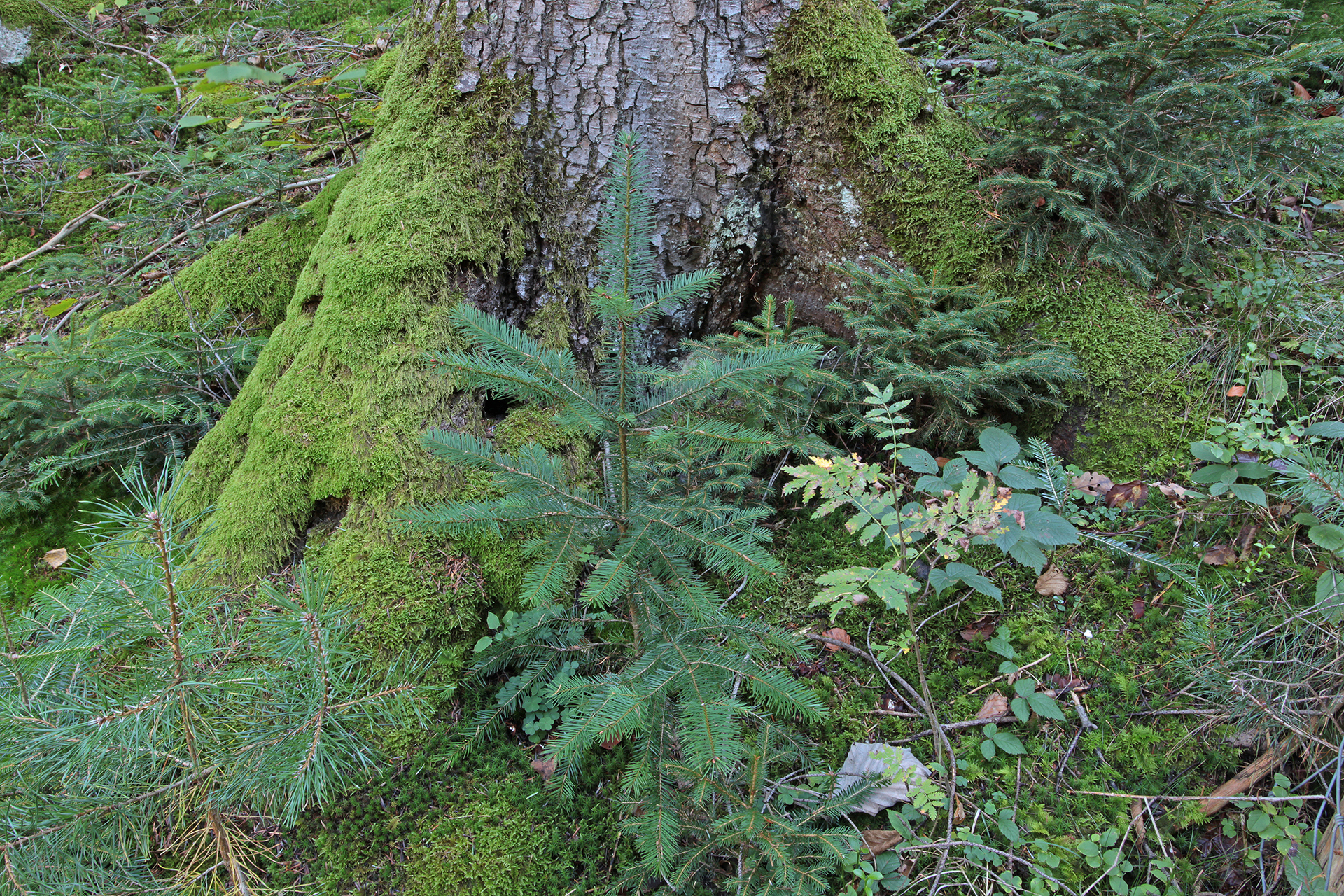
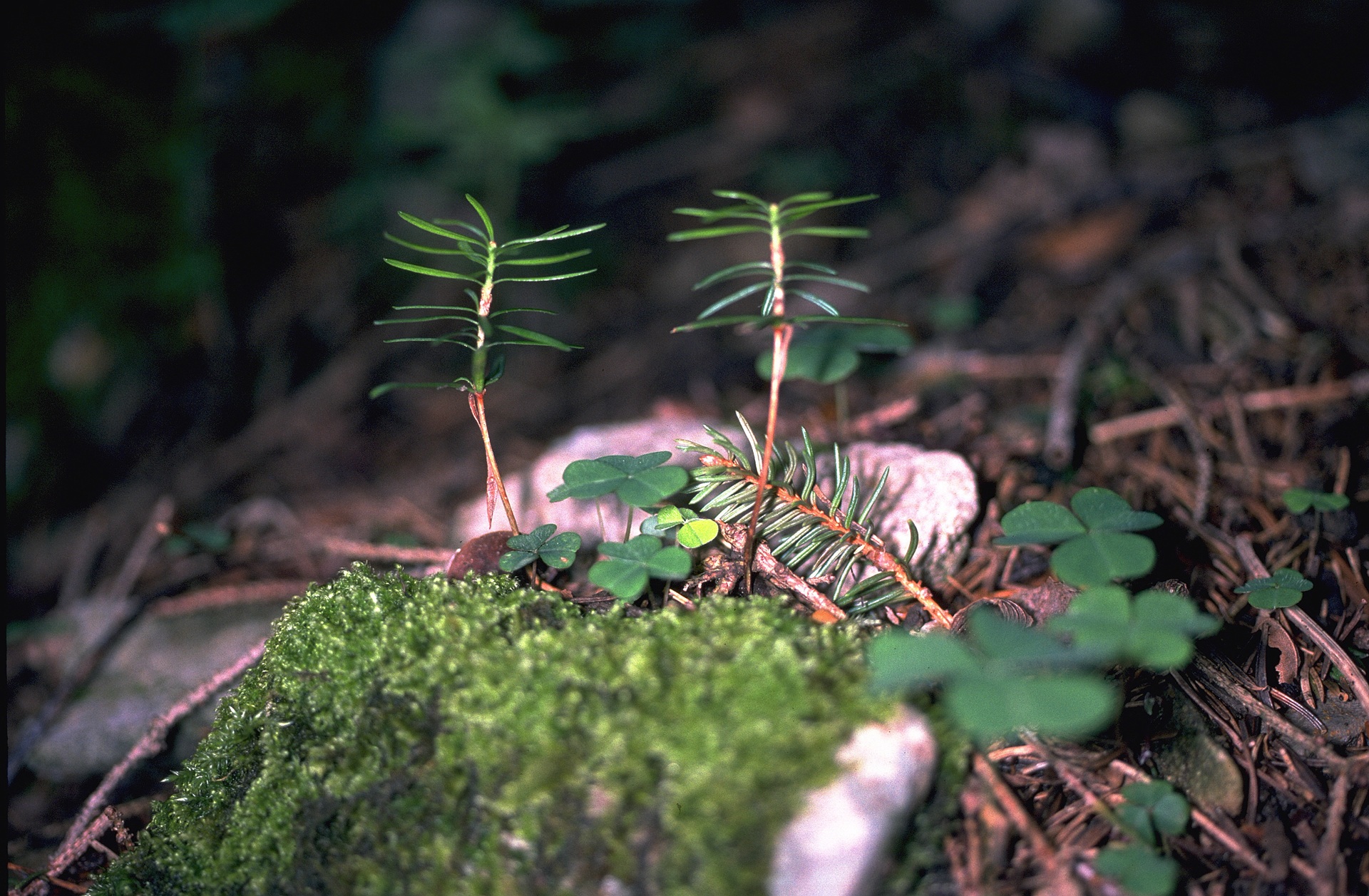
In Switzerland's forests, trees mostly reproduce naturally via seeds. This natural regeneration is a guiding principle of forestry, ensuring that trees are always adapted to their environment. However, the damage caused over the last 25 years by winter storms, drought and bark beetles shows how vulnerable our forests are to extreme events. According to climate scenarios, these will become more frequent in the coming decades.
On the other hand, the gaps left by these storms offer an opportunity for natural forest regeneration. This is demonstrated by the National Forest Inventory (NFI) conducted by the WSL: on the northern side of the Alps, the number of young trees per hectare increased significantly after the winter storms Vivian and Lothar. However, in the Central Alps, the number of regrowing trees declined – on the one hand because young trees lack light in overmature forests, and on the other because in some regions there are many wild ungulates that damage trees.
Forests in transition
Forests in low-lying areas and in the mountains also differ greatly. In the lowlands, drought and bark beetles are decimating the economically important spruce, while climate-fit tree species are not yet available everywhere. In the mountains, where the forest plays a vital role in protecting against natural hazards, stands that are too old reduce the protective effect in the long term.
Promoting young trees of climate-adapted species is therefore a key task for foresters. For this reason, the WSL is conducting various research projects on this topic, the findings of which are now being presented in a special issue of the Swiss Journal of Forestry (SZF). The researchers are reviewing and updating the recommendations that emerged in 2016 from the research programme "Forests in Climate Change". This is because not only the pressures on forests have increased since then, but also the demands placed on them, such as storing carbon and promoting biodiversity.
The articles in the special issue of the SFZ present these and other results of WSL research in detail (in German):
- Mountain forest experts present a questionnaire that helps to set priorities for the management of protective forests. (Zürcher et al.)
- Data from the National Forest Inventory (LFI) show that many young beech trees have been able to regrow at low altitudes thanks to the gaps left by storms and bark beetles. At high altitudes, however, there is often a lack of young forest. (Wohlgemuth et al.)
- As part of the long-term WSL project on mountain forest regeneration, varying numbers of trees have been felled on ten test sites in dark mountain forests since 2020 to see how young trees regrow after silvicultural interventions. (Nikolova et al.)
- Between 2020 and 2023, WSL staff planted 56 test plantations with a total of 55,000 young trees throughout Switzerland. Initial findings show that tree species that will be perfectly suited to higher temperatures in the future are already able to grow at higher altitudes today. (Schwarz & Streit)
- Since 2021, researchers have been testing young trees of six tree species in plastic tunnels at artificially elevated temperatures on three test sites. After four years, it is clear that all tested tree species grow well in deep soils, but that Douglas fir, which originates from North America, thrives best in shallow soils that are prone to drying out. (Moser et al.)
- Changes can also be observed well on the basis of old cultivation experiments. The WSL collects such findings in the " Dokutool Zukunftsbaumarten " (Glatthorn et al.).
Contact:
Barbara Moser, Tom Wohlgemuth and Petia Nikolova edited the special issue and are available for media enquiries.
Contact 
Publications 
The articles are only accessible to subscribers and will be unlocked after 6 months:
Entire issue: Swiss Forestry Journal, 02/2026 (subscribers only, free after 6 months)
Moser B, Nikolova P, Wohlgemuth T (2026)
Wird die Waldverjüngung zur Hauptaufgabe der Waldbewirtschaftung? Schweiz Z Forstwes 177 (2): 120–122. doi: https://doi.org/10.3188/szf.2026.0072
Perspektive
Glatthorn J, Jenni R, Streit K, Zürcher S (2026)
Nutzen und Limitierungen alter Baumartenversuche in der Schweiz. Schweiz Z Forstwes 177 (2): 76–80. doi: https://doi.org/10.3188/szf.2026.0076
Wissen
Moser B, Martac A, Perret-Gentil A, Scherrer D, Burini G, Gombeer S, Wohlgemuth T, Vitasse Y (2026)
Essences d’avenir sous serres: premiers résultats. J For Suisse 177 (2): 111–119. doi: https://doi.org/10.3188/szf.2026.0111
https://www.szf-jfs.ch/en/article/future-tree-species-in-polytunnel-greenhouses-first-results
Nikolova P, Kalt T, Nitzsche J, Tellenbach C, Schneider B, Schwarz J (2026)
Waldverjüngung nach waldbaulichem Eingriff: Erste Entwicklungen in hochmontanen Gebirgsnadelwäldern Schweiz Z Forstwes 177 (2): 92–101. doi: https://doi.org/10.3188/szf.2026.0092
Schwarz J, Streit K (2026)
Testpflanzungen zukunftsfähiger Baumarten – Resultate zur Anwuchsphase. Schweiz Z Forstwes 177 (2): 102–110. doi: https://doi.org/10.3188/szf.2026.0102
Wohlgemuth T, Abegg M, Kupferschmid AD, Molteni U, Moser B, Nikolova P, Scherrer D (2026)
Stammzahlen zur Verjüngung in Schweizer Wäldern nach Region und Höhenstufe 1995–2022. Schweiz Z Forstwes 177 (2): 81–91. doi: https://doi.org/10.3188/szf.2026.0081
Notiz
Zürcher S, Aeberli C, Bebi P, Frehner M, Glanzmann A, Oncelli A, Plozza L (2026)
Aktuelle Herausforderungen rund um die Verjüngung der Gebirgswälder im Klimawandel. Schweiz Z Forstwes 177 (2): 120–122. doi: https://doi.org/10.3188/szf.2026.0120
Copyright 
WSL and SLF provide image and sound material free of charge for use in the context of press contributions in connection with this media release. The transfer of this material to image, sound and/or video databases and the sale of the material by third parties are not permitted.