

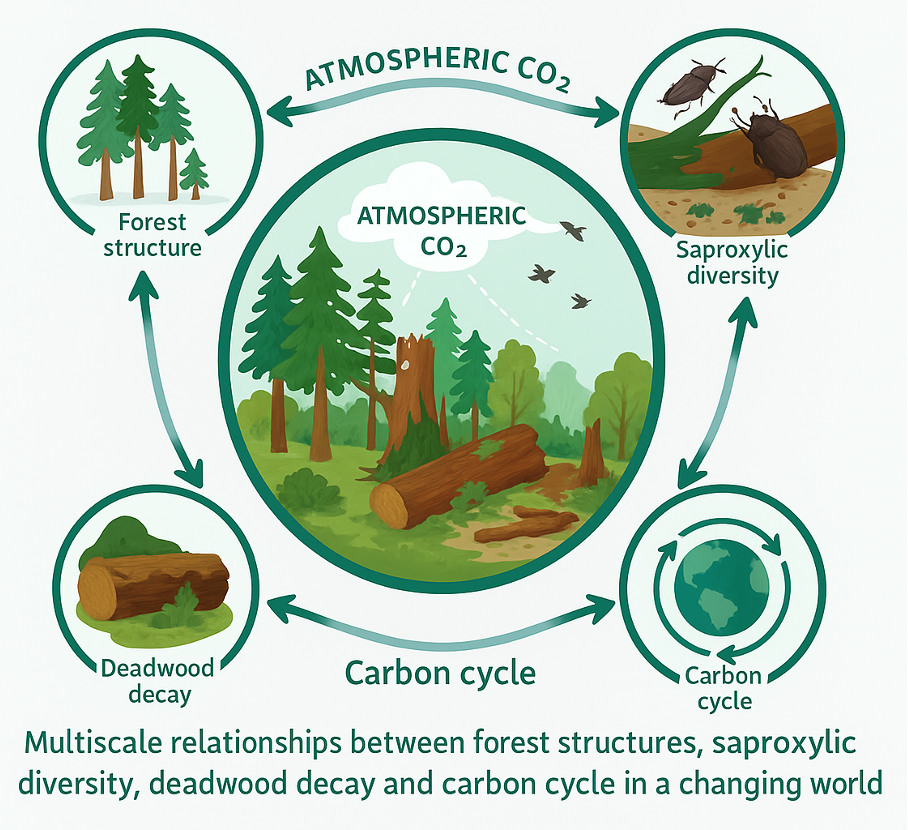
Multiscale relationships between forest structures, saproxylic diversity, deadwood decay and carbon cycle in a changing world
Harald Bugmann, Christian Ginzler, Frank Hagedorn, Martina Hobi, Thibault Lachat, Matthias Noll, Markus Schlegel, Jonas Stillhard, Guido Wiesenberg
2026 - 2029
Cooperation FinancingIn this project we focus on deadwood dynamics in forests and make use of a long-term set of forest inventory and species diversity data across Switzerland covering the most important central European forest types from lowland to high-elevation forests.
We aim at providing a holistic assessment of deadwood dynamics by considering the interplay between abiotic and biotic variables related to climate, management, forest structure and deadwood-related organisms. To achieve this, we will integrate forest inventory, soil and saproxylic species datasets, top notch remote sensing methods, detailed complementary field studies, and cutting-edge modelling exercises. This will provide novel scientific insights on the current and future dynamics of deadwood, the hotspots of functional diversity and species of conservation concern, as well as the deadwood related carbon cycle and storage of deadwood-carbon in soils.

Overview 
WP 1 – Forest structure, deadwood, and saproxylic communities 
Lead: Martina Hobi & Thibault Lachat
WP 1 investigates how forest structures – in particular deadwood originating from both management interventions and natural disturbances – shape saproxylic beetle communities from plot to landscape level and along gradients of management and disturbance intensity. It integrates existing dataset, including those from the Swiss Forest Reserves Network (www.waldreservate.ch) and extensive data on saproxylic beetles and fungi. Deadwood availability and diversity will be further characterized by using close range remote sensing methods such as mobile laser scanning and spectral data. Additional data will be collected in the vicinity of plots with standardized forest inventories and monitoring of saproxylic fungi and To upscale from plot to landscape level, deadwood information at the plot level will be linked with remote sensing data to be able to model deadwood-availability wall-to-wall. To make the link to managed forests, this WP identifies disturbance prone forests and assesses how management intensity influences the ecological importance of deadwood response of species respond to management. Together, these components will be integrated to map saproxylic biodiversity patterns across landscapes and identify conservation-relevant hotspots.
WP 2 – Temporal deadwood dynamics 
Lead: Harald Bugmann
WP 2 investigates how deadwood changes over time in Swiss forests by analysing long-term trends and projecting future dynamics under climate change. Using extensive time series from the Swiss Forest Reserve Network, it quantifies deadwood production rates, residence times, and the environmental and stand-level factors that drive them. Additional coarse woody debris data from reserves and managed forests are used to refine decay models and assess spatial patterns in density and decomposition stages. These insights feed into the development of a new dynamic deadwood model that tracks standing and lying deadwood through decay classes and is coupled with the forest dynamics model ForClim. The combined modelling framework enables projections of future deadwood development under different climate and disturbance scenarios and links deadwood turnover with soil carbon processes.
WP 3 – From deadwood to soil: carbon and nutrient fluxes 
Lead: Frank Hagedorn
WP 3 quantifies how much carbon, nitrogen, and phosphorus from coarse woody debris (CWD) enter forest soils and how this contributes to soil organic matter (SOM) formation. Using unique CWD chronosequences spanning up to 70 years, it measures nutrient pools in deadwood, forest floors, and mineral soils. The WP fractionates SOM into meaningful biochemical pools and uses stable isotopes, spectroscopic analyses, and leachate sampling to track CWD-derived inputs. Radiocarbon data help estimate residence times of carbon in both CWD and SOM fractions. Mixing models quantify the proportion of soil carbon originating from deadwood. WP 3 also assesses which biotic and abiotic factors control these fluxes by integrating climate, stand structure, and decomposer community data. The results inform both the dynamic modelling in WP 2 and the functional analyses in WP 4.
WP 4 – Synthesis, upscaling, and integration 
Lead: Martin Gossner
WP 4 synthesizes the findings from WPs 1–3 to understand how decomposer communities, deadwood decay, and carbon dynamics interact across spatial and temporal scales. It characterizes the active fractions of bacteria, fungi, and invertebrates involved in deadwood decomposition using advanced molecular tools to determine their functional roles and complementary contributions. These community data are linked with deadwood decay processes, forest structure, and environmental conditions to identify the main drivers of decomposition and carbon cycling. The WP also examines how abiotic filtering and forest management shape taxonomic and functional diversity at alpha-, beta-, and gamma-scales, and how these patterns translate into ecosystem functioning. Landscape-scale analyses integrate large beetle and fungal datasets to detect hotspots of conservation-relevant species and potential positive or negative associations that influence decay. WP 4 then combines all information into structural models that connect decomposer trajectories with deadwood production, decay, and carbon flows. Finally, it scales these processes from plots to stands and ultimately to the national level by integrating deadwood and community models with forest landscape models under climate and management scenarios. Together, WP 4 provides the comprehensive synthesis needed to project future deadwood and biodiversity dynamics in Swiss forests.
Open Positions 
Cluster hire of four PhD positions and one PostDoc position
