

Researchers at the Swiss Federal Institute for Forest, Snow and Landscape Research (WSL) have, for the first time, been able to record a debris flow over a distance of two kilometres at the Illgraben (VS). The data reveals where and how waves form within the flow and what happens when they pass over check dams.
- Data on debris flows is often collected selectively because measurements are labour-intensive and expensive.
- WSL researchers have now, for the first time, obtained a continuous record of debris flows and the waves they generate over a distance of two kilometres.
- The data show that waves grow larger the further they move down into the valley and that the point at which waves form within the debris flow also moves downstream.
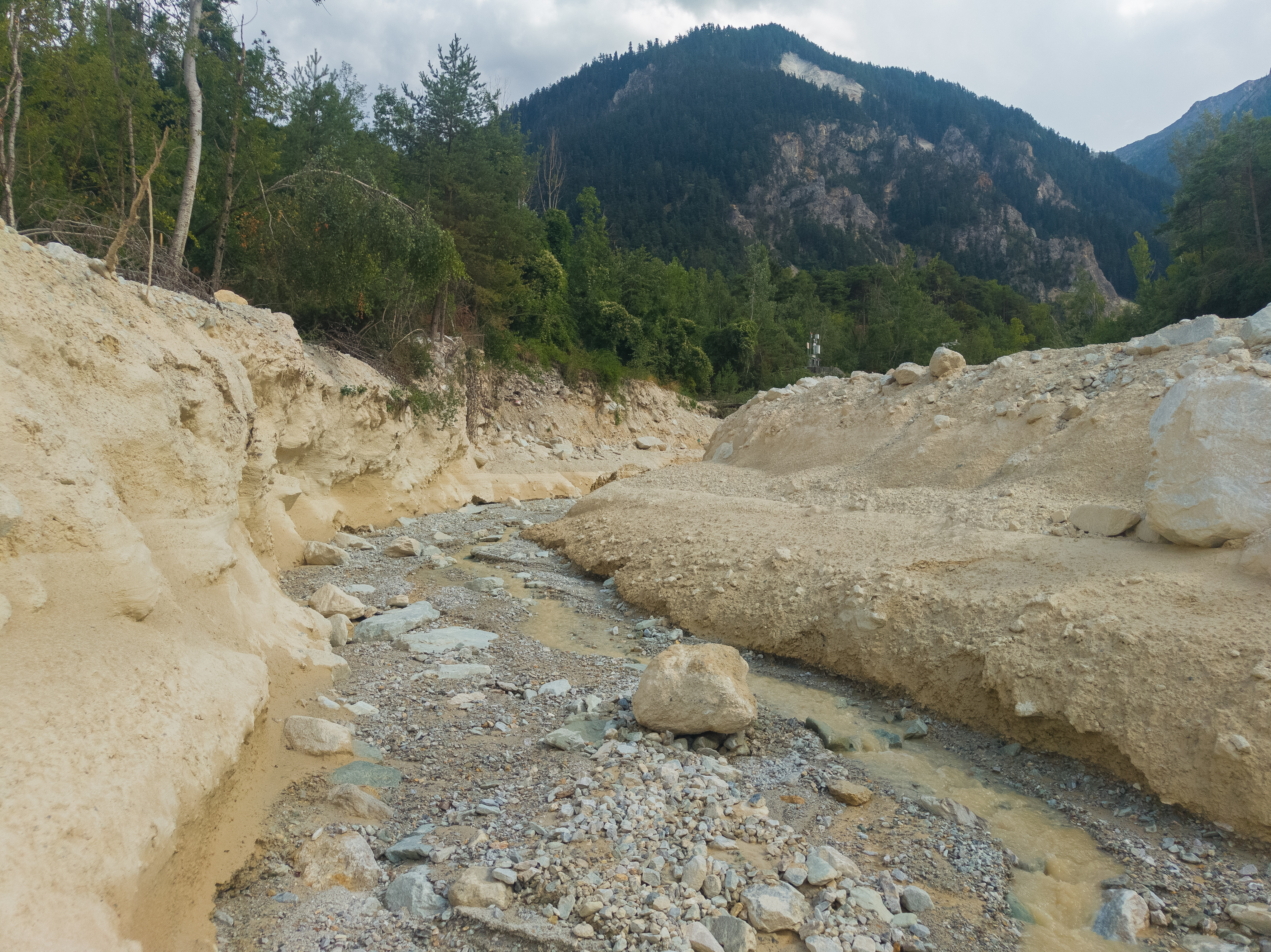
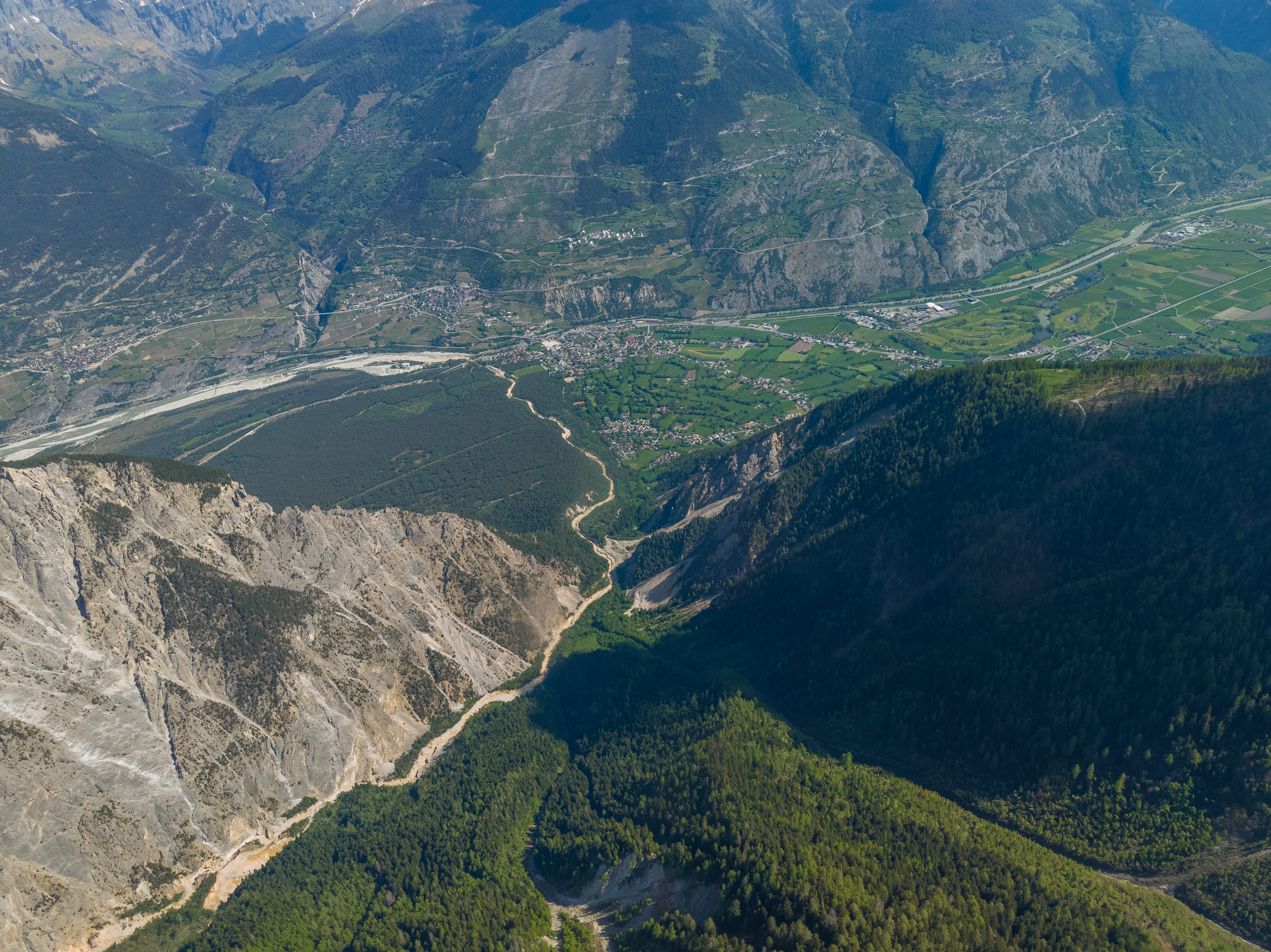
The Illgraben in the canton of Valais is unique in Switzerland: here, debris flows occur several times a year – more frequently than almost anywhere else in Europe. Boulders weighing several tonnes and up to 4000 truckloads of debris can rush down the valley during a debris flow. For researchers, this is a stroke of luck. The torrent offers the rare opportunity to systematically observe and analyse debris flows. Now, for the first time, WSL researchers succeeded to record debris flows from start to finish and thus track their development.
Measurements over a distance of two kilometres 
A debris flow is a very fluid landslide that resembles a muddy flood wave. It usually moves within stream beds or channels but can spill over. During a debris flow, a massive amount of mud and debris thunders down a valley. There’s even a possibility that metre-high surge waves, moving faster than the rest of the debris, develop. Until now, the formation and expansion of such surges had not been explained.
Monitoring stations for debris flows are time-consuming to install and expensive. Consequently, the phenomenon is usually measured only in a single spot. However, in order to better understand how waves develop, researchers need measurements along the entire length of a debris flow. To obtain such measurements, the WSL has adopted a new approach and installed geophones along a two-kilometre stretch of Illgraben’s channel bed. Geophones are small measuring devices capable of recording vibrations in the ground. Because waves of different sizes and boulders cause vibrations of varying intensity, the researchers can use geophone data to reconstruct how debris flows make their way down the valley.

“This new measurement method permits a more complete picture of debris flows”, says geophysicist Christoph Wetter, lead author of the study published in the journal Engineering Geology. “We can now trace the entire debris flow in time and space.”
This makes it possible to understand wave formation in a debris flow: waves start small and grow larger as they descend into the valley. The measurements also showed for the first time that the region where the waves form is not stationary but moves downwards as well, as Wetter explains. Furthermore, the waves do not become smaller when they pass check dams. These are not designed to reduce the muddy floods but rather to guide them into a certain direction and stabilize the channel bed. However, how the waves pass through them has been unclear until now.
Improved protective measures thanks to better data 
This is no cause for concern, explains the researcher – at least at the Illgraben. There, the existing infrastructure effectively protects the neighbouring municipality. However, this insight is important for places where unprotected buildings are situated next to debris flow prone streams. The WSL’s research at the Illgraben thus not only serves to better understand debris flows and their development, but it also shows how communities can optimally plan protective infrastructure.
Contact 
Publications 
Projects 
Copyright 
WSL and SLF provide image and sound material free of charge for use in the context of press contributions in connection with this media release. The transfer of this material to image, sound and/or video databases and the sale of the material by third parties are not permitted.