

In CLIMAGS, you can explore how different aspects of agriculture in Switzerland will be affected by climate change. Will rapeseed yields become less stable in the future? How much more frequently will drought conditions occur for grasslands? Can cherry trees still be pollinated under climate change? And how are soil organic carbon stocks affected?
Available indicators in the app 
Annual yield 
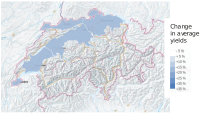
Indicator of agricultural productivity
The app shows the change in average annual yield of grassland and the most important arable crops until 2060. This enables producers to make better decisions about which crops to prefer in the future.
Yield fluctuation 
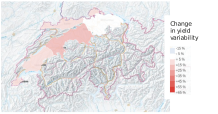
Indicator of food production stability
In addition to the average yield of grassland and arable crops, the app also provides information about future variability of annual yields. These variations are a key indicator of food production stability. Such fluctuations are caused by factors including extreme weather conditions. The greater the fluctuations, the lower the reliability of agricultural production. Information on the extent of yield fluctuations helps producers and insurance companies to assess risk.
Soil carbon stock 
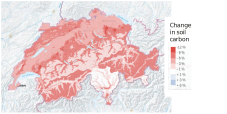
Indicator for the ecosystem service of carbon storage
The app shows the future development of soil carbon stocks in the top 30 cm of grassland and arable land soils. A decrease in soil carbon leads to CO2 emissions. At the same time, soil fertility is related to the carbon stored in the soil. With the help of the app, regions can be identified where soil fertility could decline in the future.
Pollination potential 
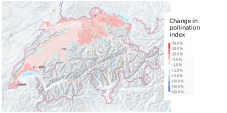
Indicator for the ecosystem service of pollination
Pollination is a basic prerequisite for yield and the yield quality of many agricultural crops. Depending on the pollination requirements of the plant species in question, the degree of pollination can have a more or less pronounced impact on yield. Pollination potential in spring and summer was calculated for the pollination-dependent crops apple, cherry, and rapeseed. Producers can use this information to develop location-specific and seasonal habitat management for wild bees with suitable habitats for food and nesting, thus ensuring pollination performance under future climate conditions. This also includes selecting crops whose flowering time is favorable for pollination.
Publications 
Contact 
Pierluigi Calanca, Kevin Kramer, Márcio dos Reis Martins, Chloé Wüst-Galley (Agroscope),
Sibylle Stöckli (University of Geneva)
This work was funded by the National Centre for Climate Services NCCS and carried out as part of the programme “Decision Support for Dealing with Climate Change in Switzerland (NCCS-Impacts)” as part of the project “Impacts of climate change on ecosystem services”.