

Pascal Haegeli has led the research unit Snow Avalanches and Prevention at the WSL Institute for Snow and Avalanche Research SLF since 1 June 2026. While on a walk around Lake Davos, he tells us how he intends to develop the avalanche warning system and why he wants to bring social sciences to the SLF for the very first time.
- Focusing on people: Research aims to better understand how avalanche warnings work.
- Improve avalanche warnings: The natural and social sciences should work together to provide clearer information and improve safety.
- Climate change is changing avalanches: The danger remains – only the avalanches themselves are changing.
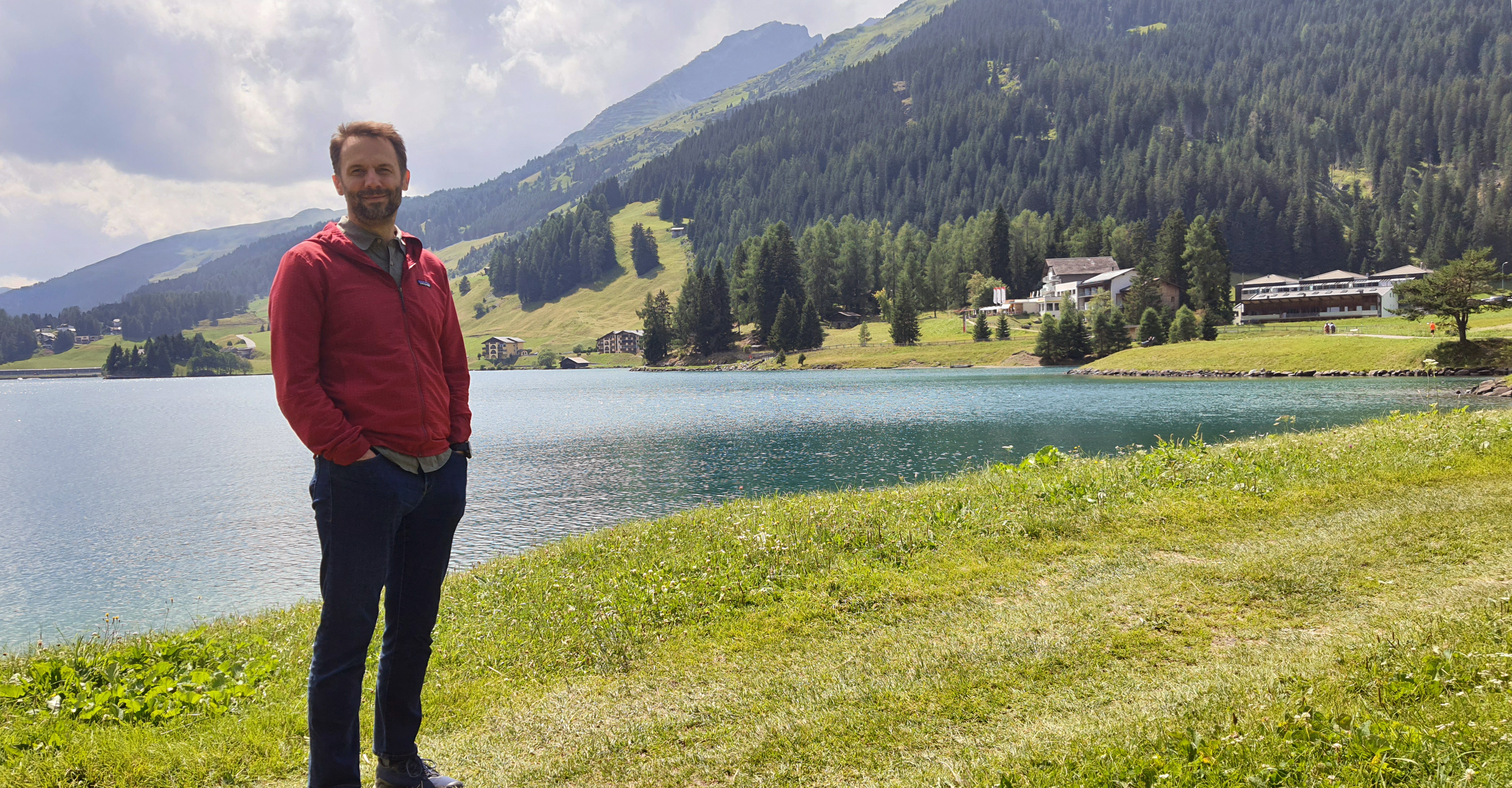
Mr Haegeli, you took over the reins of the SLF’s Snow Avalanches and Prevention research unit on 1 June this year. In light of climate change and the resulting winters with little snow, is it still worth investing a lot of money in avalanche research?
Of course. There will still be enough snow for avalanches in the coming decades. The nature of the avalanches themselves will change, and we need to prepare ourselves properly for this. There will be new extreme situations that differ from those we’ve seen previously. People in the Alps will have to adapt to this. A general rise in temperature doesn’t simply mean fewer avalanches. It’s a bit more complex than that.
What will your research focus on in the coming years?
For now, the priority is to really get to know my research unit and the avalanche community in Switzerland. As I’m coming from abroad, I’ve got a lot to learn in that regard. Perhaps you could call this ‘personal research’. We can then work together to plan where we should be heading over the next few years.
You previously lived and conducted research in Canada for 28 years. Is the scientific environment different?
My situation here is completely different. In Canada, I worked at a university and was the only avalanche researcher for miles around. That’s why we were more or less only able to discuss research within my group. What’s more, my closest colleagues in the field were between six and ten hours’ drive away, which made day-to-day communication a little more difficult. It’s rather different at the SLF. It’s brilliant to have so many avalanche researchers under one roof and to have practitioners right on my doorstep.
You set up your own consultancy firm, Avisualanche Consulting, while you were working on your PhD in Vancouver. Is the firm still up and running?
No. I ceased my work with Avisualanche Consulting after I was appointed to my professorship at Simon Fraser University in 2015. I sort of just fell into it myself, actually. In winter 2003, so the final winter of my PhD, there were two major avalanche accidents in Canada, each claiming seven lives. In response, a number of projects were launched to modernise avalanche warnings, training and risk management. I had the opportunity to lead one of these projects, and that was what prompted me to set up my own company at the time. That was also when I first began to look more closely at the social sciences in order to gain a better understanding of how to communicate avalanche risk more effectively. When I was appointed to my professorship, I continued this work at the university.
Will you keep working on risk communication?
I’ll definitely be pursuing this topic at the SLF as well. It’s important to understand how our customers – recreational sports enthusiasts, but also avalanche services – read, understand and use our products. This is the only way we can ensure that we convey the right information and that our message is understood correctly.
That doesn’t sound much like natural science. Does that mean you’ll be bringing the social sciences to Davos for the first time in the SLF’s history?
I think it would be a good idea. Risk communication is a key aspect of the entire chain of prevention, which starts with the processes taking place within the snowpack and ends with the use of avalanche warnings.
Researchers in the natural sciences are often sceptical of the social sciences.
I realise that the social sciences tend to be looked down upon by the natural sciences. But I believe that the social sciences are in no way inferior to the natural sciences. Systematically researching the effectiveness of our products and producing results that help us improve them is no easy task.
And how do you intend to persuade the two fields to work together?
I understand that, given the SLF’s long history with the natural sciences, this might not be entirely straightforward. But I come from an institution where researchers in the applied natural and social sciences work very closely together to tackle the challenges currently facing society, such as climate change and the sustainable use of resources. The natural sciences inform the social sciences, and vice versa. And we need both perspectives if we’re to solve the avalanche issue. No one would deny that the human factor plays a major role in avalanche accidents.
That’s the core task of the SLF’s avalanche warning service, which falls within your remit. Any ideas yet on how the service could be further improved?
The team is already working hard on new models to produce more accurate, higher-resolution regional forecasts. We also need to consider how we can incorporate the latest research findings on avalanche formation and dynamics into our products. And then – and this brings us back to the social sciences – we have to look into how best to present this information to end users. This isn’t just about how the avalanche bulletin is used by recreational sports enthusiasts, but also about the services we provide to avalanche services, engineering firms and so on.
Link 
Research Unit Avalanches and Prevention
Contact 
Copyright 
WSL and SLF are making image and audio material available free of charge for use in press coverage related to this press release. The inclusion of this material in image, audio, and/or video databases, as well as its sale by third parties, is not permitted.