

05.05.2026 | Stephanie Kusma | WSL News
How could life in Switzerland develop socially, economically and politically by the end of the century? Researchers at the Swiss Federal Institute for Forest, Snow and Landscape Research WSL investigated this as part of the NCCS-Impacts programme. The result? Five scenarios with significantly different impacts on greenhouse gas emissions, as shown by modelling in a new publication.
- Scenarios for Switzerland: WSL researchers have developed five Shared Socioeconomic Pathways for Switzerland (SSP-CH).
- Exploring possible futures: The SSP-CH outline possible pathways for how society could develop socially, economically and politically, without assigning probabilities to these developments.
- Modelled emissions: A new publication released under the umbrella of the National Centre for Climate Services NCCS presents modelled greenhouse gas emissions for Switzerland up to the year 2100, with reference to the SSP-CH and various climate policies.
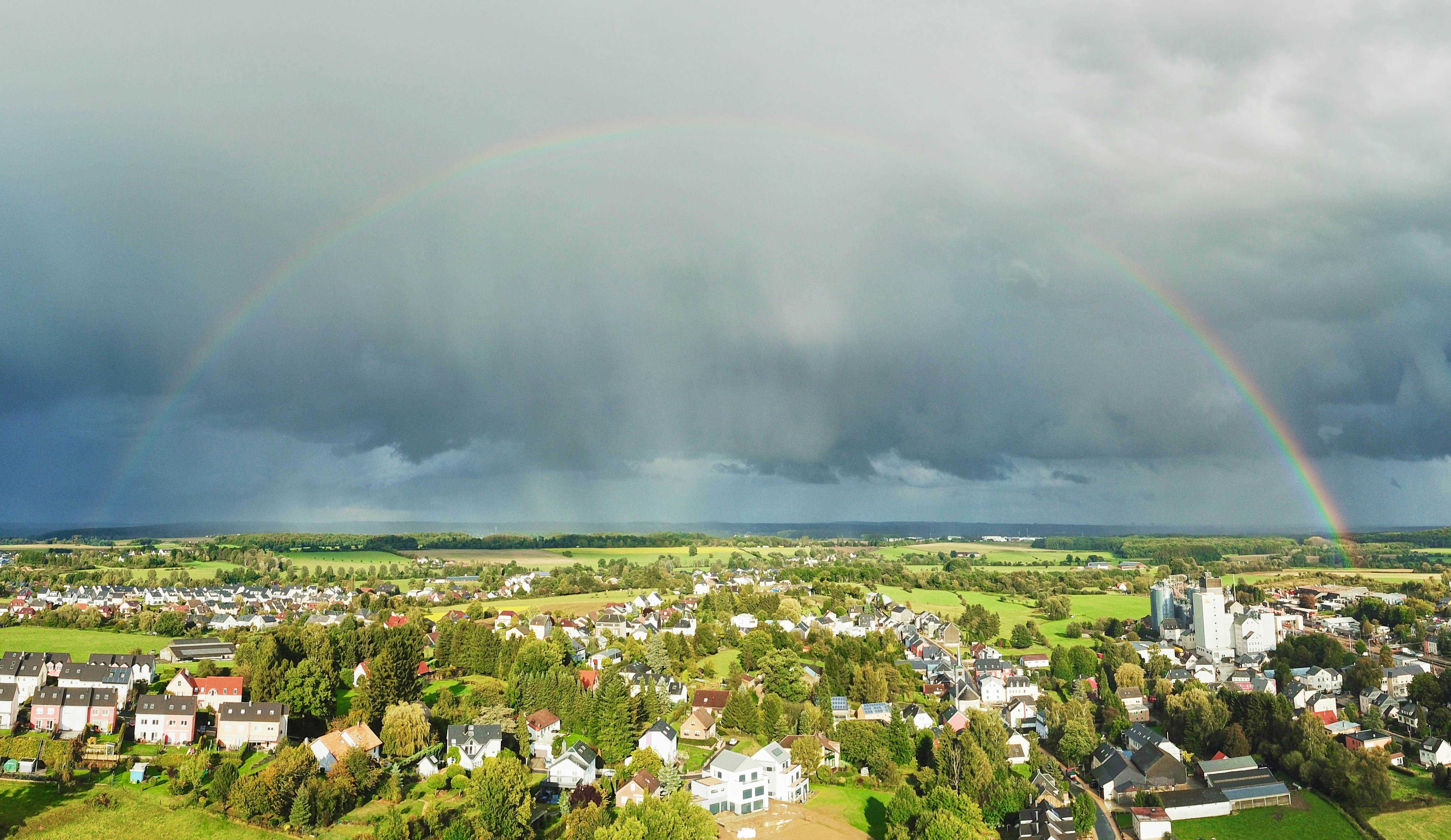
Switzerland, 1952: Women’s suffrage was still a distant prospect. People watched films at the cinema; radio was the main electronic mass medium. There was no regular SRG television programming, nor were there any motorways. At ETH Zurich, Eduard Stiefel was building ERMETH (the Electronic Calculating Machine of the ETH), one of Europe’s first computers. The rise of rock ’n’ roll was on the horizon. Fewer than five million people lived in Switzerland.
From changing values to mobility 
Today, Swiss society looks very different. But what will it look like in 74 years’ time, at the end of the century? “We can’t say for certain,” explains WSL geographer Lena Gubler. “Developments are too unpredictable. The system is too complex, with too many interacting factors.” However, it is important to consider possible societal development pathways. Socioeconomic and political developments influence resource consumption, climate change and infrastructure needs, among other factors. Scientifically devised scenarios outlining and comparing possible developments are a useful way to look ahead.
The Intergovernmental Panel on Climate Change (IPCC) has long used global socioeconomic scenarios (Shared Socioeconomic Pathways, or SSPs) for climate modelling. As part of the National Centre for Climate Services NCCS’ NCCS-Impacts programme, Gubler and her WSL colleague Pascal Tschumi have developed five socioeconomic scenarios for Switzerland (Shared Socioeconomic Pathways-CH, or SSP-CH). With reference to these as well as various climate policies, project partners (INFRAS und PROGNOS) then modelled possible future greenhouse gas emissions (see Box 2). The findings have now been published under the NCCS umbrella.
Five futures 
The scenarios present five possible development pathways. Three of these resemble the IPCC’s global SSPs. In one, the economy and society are highly technologised and based on renewable energy; in another, the state and economy are weak and society fragments. Another paints a picture of a deeply divided society in which a small elite faces an impoverished majority of the population.
Two scenarios differ from the global SSPs. One depicts a Switzerland that long relied on fossil fuels and, towards the end of the century, struggles with the effects of volatile and high energy prices as well as the costs of a severely degraded environment. The final scenario describes a society in which cohesion and well-being are more important than economic success and financial prosperity.
“None of our scenarios is more likely than another,” emphasises Gubler. “The aim is to explore variations of what conceivable futures might look like, based on an if-then approach, not to make statements about the likelihood of these scenarios or aspects of them.”
Making informed decisions 
The scenarios serve as a basis for discussion in order to better assess the impacts of long-term decisions. “The project partners developed dedicated models to translate these descriptive visions of the future into greenhouse gas emissions,” outlines Gubler. “However, the SSP-CH can also be used for other future-oriented work.”
This is because they make it possible to take potential societal changes, such as shifts in consumer behaviour or new social structures, into account in further scenarios, such as those relating to the Swiss economy, transport, the state of biodiversity or in risk analyses. “This makes a significant contribution to a holistic view of possible developments,” explains the researcher.
On a dedicated website, the researchers present all the data developed in the project, the SSP-CH, packages of climate policy instruments (Shared Policy Assumptions, or SPAs) and the modelling of greenhouse gas emissions.
Broad-based foundation
To develop the SSP-CH, the WSL team held discussions with almost 60 scientists from 20 research institutions and universities in German- and French-speaking Switzerland. These discussions covered a wide range of socioeconomic topics, from domestic security and mobility to spatial development and education. The researchers then used a specialised computer program to derive internally consistent scenarios from the interviews with the experts, which they subsequently discussed and expanded upon in workshops with interested members of the public in German- and French-speaking Switzerland.
As part of the SSP-CH project, the project partners at the consultancy firm INFRAS devised packages of climate policy instruments (SPAs), ranging from a strongly interventionist to a minimal climate policy. Based on the scenarios and climate policies, an INFRAS team, together with the consultancy firm PROGNOS, modelled potential developments in greenhouse gas emissions and land use in Switzerland up to 2100.

NCCS: the network for climate services
As a national coordination and innovation body and a centre for knowledge, the NCCS provides a basis for climate compatible (klimakompatibel?) decision-making with the aim of minimising risk, maximising opportunities and optimising costs. In the NCCS programme ‘Decision Support for Dealing with Climate Change in Switzerland: a cross-sectoral approach’ (NCCS-Impacts), actionable climate services for the environment, economy and society were developed from 2022 to 2026 in multiple cross-sectoral projects. These are intended to serve as a basis for decision-making for stakeholders from politics, public administration, private sectors and research regarding measures to prevent greenhouse gas emissions and adapt to climate change. The NCCS-Impacts programme is jointly supported by all members of the NCCS. From autumn 2026, all results will be available in a consolidated overview. www.nccs.ch
Contact 
Links and documents 
WSL publications 
Publications 
Copyright 
WSL and SLF provide image and sound material free of charge for use in the context of press contributions in connection with this media release. The transfer of this material to image, sound and/or video databases and the sale of the material by third parties are not permitted.